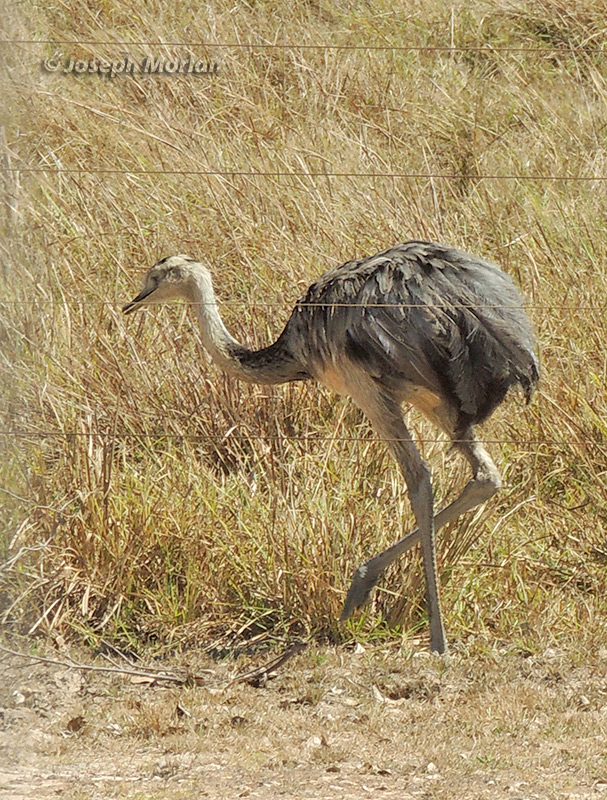
This is the largest and heaviest bird of the Americas. Although widespread in Eastern and Central South America, its population continues to decline resulting in an IUCN status of "Near Threatened." Hunting and destruction of grassland for agriculture are the primary threats. Formerly included with Ostriches in the Struthioniformes, Rheas are now classified in their own order, the Rheiformes. Their mating system is both Polyandry and Polygyny. Males mate with multiple females and females mate with multiple males. The nest is attended only by the male who incubates and cares for young from multiple females. Five subspecies are usually recognized, but their distribution is uncertain. This is presumably R. a. araneipes which is reportedly the race occurring on southern Mato Grosso. It is described as relatively large with black on the lower third of its neck (Blake 1977).
References:
Blake, E. R. 1977. Manual of Neotropical Birds. Volume 1. University of Chicago Press, Chicago, Illinois.
Hodes, C.. 2010. Greater Rhea (Rhea americana), Neotropical Birds Online (T. S. Schulenberg, Editor). Ithaca: Cornell Lab of Ornithology; retrieved from Neotropical Birds Online
Nikon P510