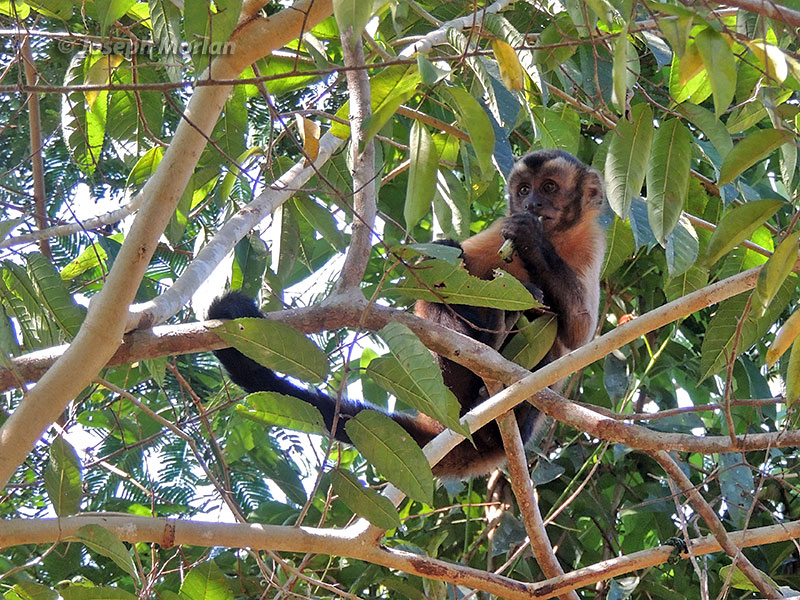
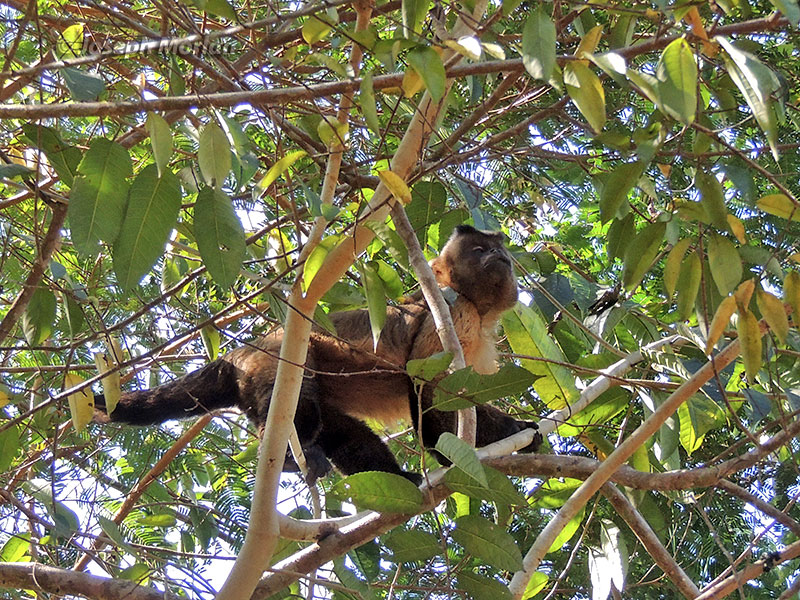
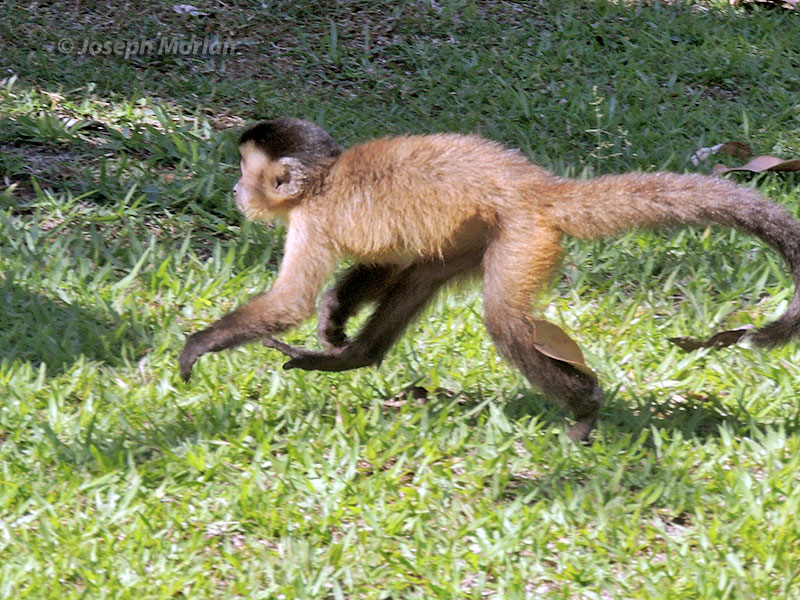
One presumed female near the lodge at the top, an adult male in the middle and an immature at the bottom. The Tufted Capuchin is unique among Capuchin monkeys in that it does not use its prehensile tail for locomotion. However it does use it for support while foraging as seen above. They are also noted for their use of tools to retrieve and open food. Their taxonomy is highly controversial. Recent proposals call for splitting the traditional Tufted Capuchin into two groups, robust (tufted) and gracile (untufted) each in a different genus and each with several species. Under this classification, Capuchins at Cristalino are in the robust group and are named Sapajus apella apella. Formerly both groups were placed in the genus Cebus. Capuchins in the Pantanal are now recognized as a separate species, Black-striped Capuchin (S. libidinosus).
References:
Lynch Alfaro, J.W.; et al. (2011). "Explosive Pleistocene range expansion leads to widespread Amazonian sympatry between robust and gracile capuchin monkeys." Journal of Biogeography 39: 272–288. [PDF]
Rylands, A.B., Boubli, J.-P., Mittermeier, R.A., Wallace, R.B. & Ceballos-Mago, N. 2015. Sapajus apella. The IUCN Red List of Threatened Species 2015: e.T39949A70610943. http://dx.doi.org/10.2305/IUCN.UK.2015-1.RLTS.T39949A70610943.en . Downloaded on 05 October 2015.
Nikon P510