Ornithology 3A Summary (Fall 2011)
If you miss a class, please check this page and study the listed topics in your field guide. For last year's summary, click here.
Class notes by Elisabeth Koster are here.
Please register at eBird and email me your eBird ID. I can then offer to share field trip lists with you.
Click here for a summary of bird name changes from the 52nd AOU supplement.
Click here for my first impression review of the 6th edition of the National Geographic Guide. I recommend everybody upgrade to this edition as soon as possible.
Additional references:
Dunn, J.L., J. Morlan and C.P. Wilds. 1987. Field identification of forms of Lesser Golden-Plover. International Bird Identification - Proceedings of the 4th International Identification Meeting Eilat 1st-8th November 1986. (Click here for a pdf of this paper.)
Johnson, O. W., and Johnson, P.M. 2004. Morphometric features of Pacific and American Golden-Plovers with comments on field identification.Wader Study Group Bull. 103:42-49. (Click here for pdf).
Jarmillo, A. 2004. Featured Photo: Identification of adult Pacific and American Golden-Plovers in their southbound migration. Western Birds 35:120-124. (Click here for pdf and here for the photos.)
Brewer's/Rusty Blackbird photos discussed in class.
Note: There is no class next week. Class resumes December 1st .
David Sibley has an essay on distinguishing Common Moorhen from Common Gallinule here.
The "Birds of North America" account for Common Gallinule mentions, "Chick has a 1- to 1.5-mm-long spur on alula (wing) that permits grasping when chick climbs emergent vegetation, enters nest, or clings to submerged vegetation when swimming underwater (Bent 1926, Miller 1946, Wood 1974, Greij 1994)." This may be what appeared to be an external wing-claw in one photo.
Click here for my photo of a Clapper Rail in Louisiana. Click here and here for my Clapper Rail photos from California. Click and here and here for my photos of a Virginia Rail with chicks. Click here, here and here for my photos of Sora. Click here for photos of a Black Rail at Pt. Reyes.
This was the last class of the quarter. Please click here to register for part B. Course numbers, dates and descriptions are here.
We reviewed the raptors on pages 124-144.
We completed the falcons on page 140 and reviewed the raptors on pages 124-140. Click here for my Peregrine Falcon photo and discussion. Click here for a photo of a Gyrfalcon in Solano County.
Sibley's essay on wing translucence here.
We completed the kestrels and merlin on page 138 and reviewed the raptors on pages 124-138. Click here for my photo of an American Kestrel eating a Jerusalem Cricket. Click here and here for my photos of a Merlin at Sutro Heights Park; and here for my photo of a Merlin at Point Reyes. Click here for my photo of a "Prairie" Merlin (F. c. richardsonii) in Pacific Beach, San Diego.
Reference
Hull, A.C. et al. 2008. First documentation of a Eurasian Kestrel in California. Western Birds 39:184-187 (PDF) (IMAGES)
We completed the falcons and caracara on page 136 and reviewed the raptors on pages 124-136. Click here for photos and my account of a Crested Caracara at Davenport. Additional photos of Crested Caracaras in California are here, here, here, here, here, here, here, here, here, here, here, and here.
We completed the hawks on page 134 and reviewed the raptors on pages 124-134. Click here and here for photos of a light morph Ferruginous Hawks at Point Reyes. My image of a dark morph Ferruginous Hawk at Point Reyes is here (North Bay Birds membership may be required).
Click here for my photo of a White-tailed Hawk in Texas.
We completed the hawks on page 132 and reviewed the raptors on pages 124-132. Click here for a photo and discussion on a juvenile Red-tailed Hawk that somewhat resembles a Broad-winged Hawk. Click here, here, here, here and here for my photos of Red-tailed Hawks in the Bay Area. Additional Red-tailed Hawk images are here and here.
Click here for a photo of a "Harlan's" Red-tailed Hawk in Arcata.
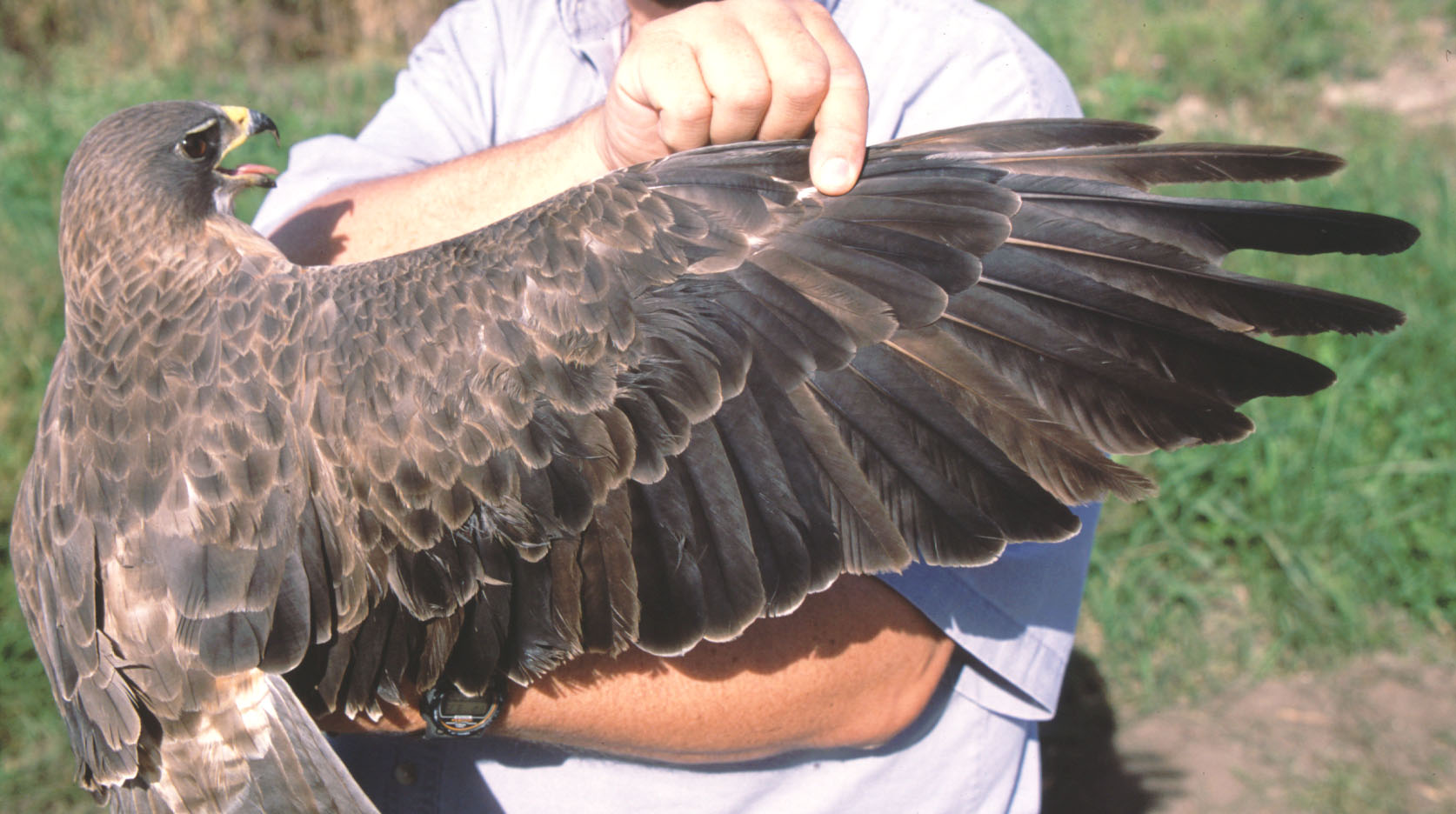
Click here for a photo and discussion of a juvenile Swainson's Hawk. Additional Swainson's Hawk photos are here and here. A hand-held Swainson's hawk showing staged wing molt is here.
Additional References
Clark, W. H. 2009. Extreme variation in the tails of adult Harlan's Hawks. Birding 41:30-36 (PDF)
[Caution advised.]
Hull, J.M. et. al. 2010. Population structure and plumage polymorphism: The intraspecific evolutionary relationships
of a polymorphic raptor, Buteo jamaicensis harlani. BMC Evolutionary Biology 10:224 (PDF).
Liguori, J. and B.L. Sullivan. 2010. A study of Krider's Red-tailed Hawk. Birding 42:38-45 (PDF)
Mindell, D.P. 1983. Harlan's Hawk (Buteo jamaicensis harlani): A valid subspecies. Auk 100:161-169
(PDF).
More details on the Cape May Warbler and Common Ringed Plover which we discussed in class are here.