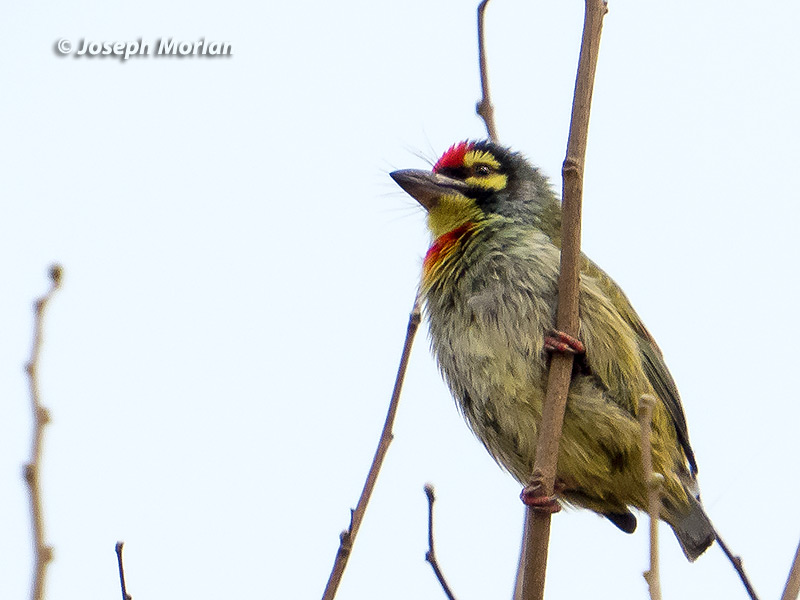
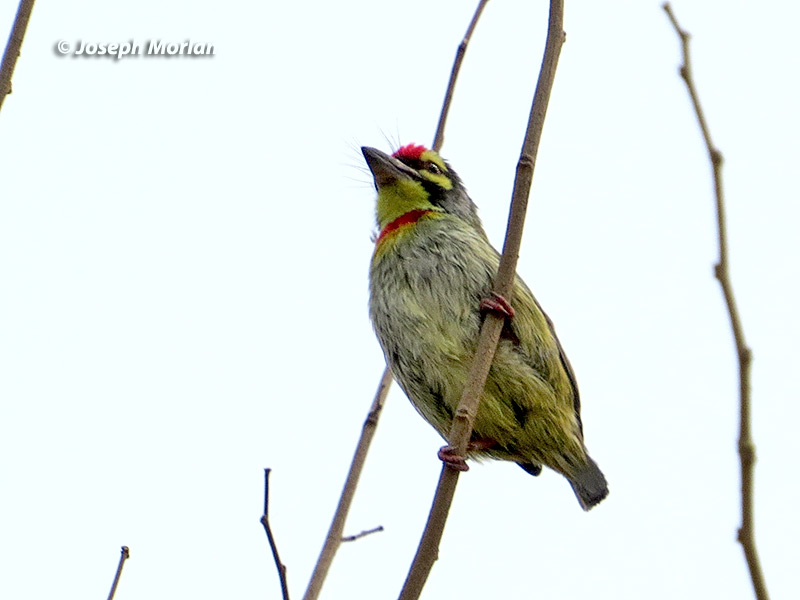
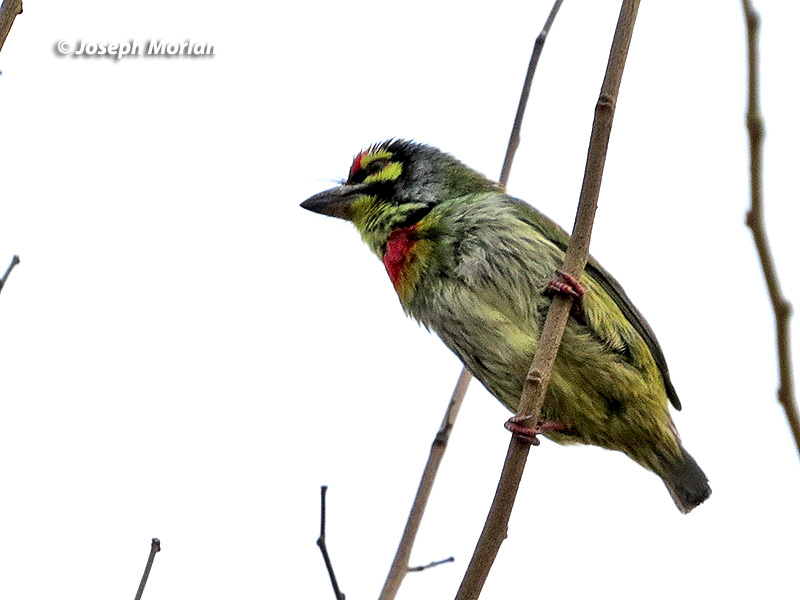
All the barbets were formerly (e.g. HBW) classified in the family Capitonidae. However recent studies have found that they are paraphyletic with respect to the New World Toucans, resulting in an invalid clade unless the Toucans are included. For this reason, most recent authors (e.g. Clements) prefer to divide the former Capitonidae into four separate families, Lybiidae (African Barbets), Megalaimidae (Asian Barbets), Semnornithidae (Toucan-Barbets), and Capitonidae (restricted now to New World Barbets). This species along with many other Asian barbets was formerly included in the genus Megalaima. However molecular evidence found that genus to be polyphyletic, so the earlier name Psilopogon took priority and replaced all of them. Nine subspecies are recognized. This is the widespread continental race P. h. indica in which the amount of red on the face and throat is much reduced.
Coppersmith is one of the most widespread of the Asian Barbets and the only one that routinely occupies open country away from forests. This individual was calling incessantly giving hollow "took" notes recalling the vocalization of the New World Ferruginous Pygmy-Owl (or perhaps the sound of a copper-smith pounding on metal). Each time the bird called, the feathers of its throat would stick out revealing the dark color at the base of the feathers. Canon PowerShot SX50 HS
Reference
den Tex, Robert-Jan; Leonard, Jennifer A. 2013.. A molecular phylogeny of Asian barbets: Speciation and extinction in the tropics. Molecular Phylogenetics and Evolution 68:1-13.