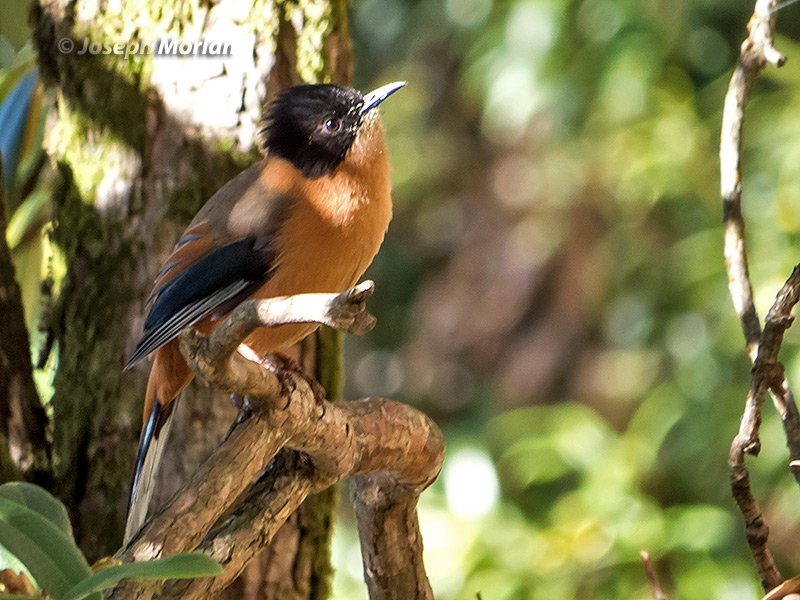
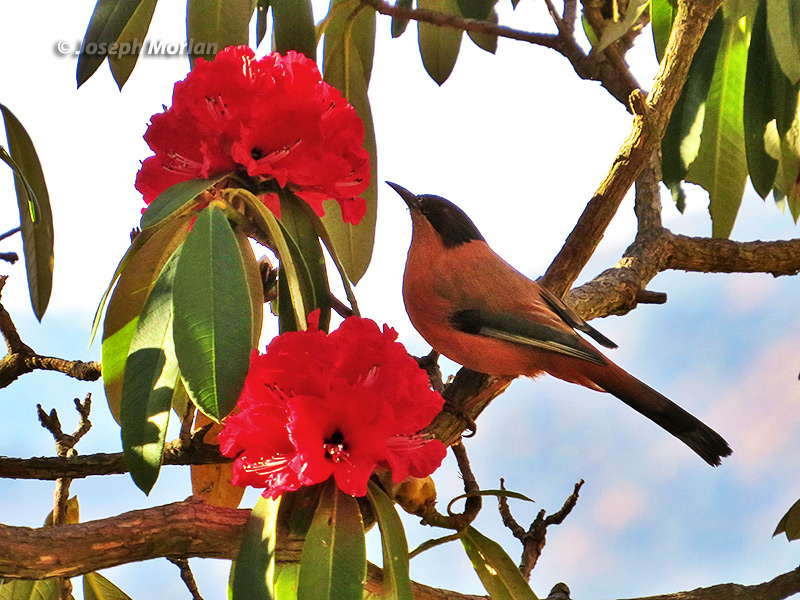
Foraging in flowering Tree Rhododendron (Rhododendron arboreum), this species is endemic to the northern Indian subcontinent. It was formerly included in the Babbler family, but is now usually recognized as a member of the Laughingthrushes (Leiothrichidae). HBW and Rasmussen retain it with the Babblers but place this species in the genus Malacias restricting Heterophasia to the Long-tailed Sibia. Three subspecies are recognized. Birds in the west (nominate) are paler with grayish back, while birds in the east are browner above. I judge this to be the bright rufous H. c. nigriceps from the central part of its range. However I photographed a gray backed individual in the same area (top) indicating either individual variation or some overlap between the subspecies during the non-breeding season. Canon PowerShot SX50 HS.
References:
Ali, S & SD Ripley (1987). Compact Handbook of the Birds of India and Pakistan. Edition 2. Oxford University Press.
Collar, N. & Robson, C. (2016). Rufous Sibia (Malacias capistratus). In: del Hoyo, J., Elliott, A., Sargatal, J., Christie, D.A. & de Juana, E. (eds.). Handbook of the Birds of the World Alive. Lynx Edicions, Barcelona. (retrieved from http://www.hbw.com/node/59661 on 7 September 2016).
Rasmussen, P.C. & Anderton, J.C. (2012) Birds of South Asia. The Ripley Guide. Vols. 1 and 2. Second Edition. Smithsonian Institution. Michigan State University & Lynx Edicions, Washington. D.C., Michigan & Barcelona.