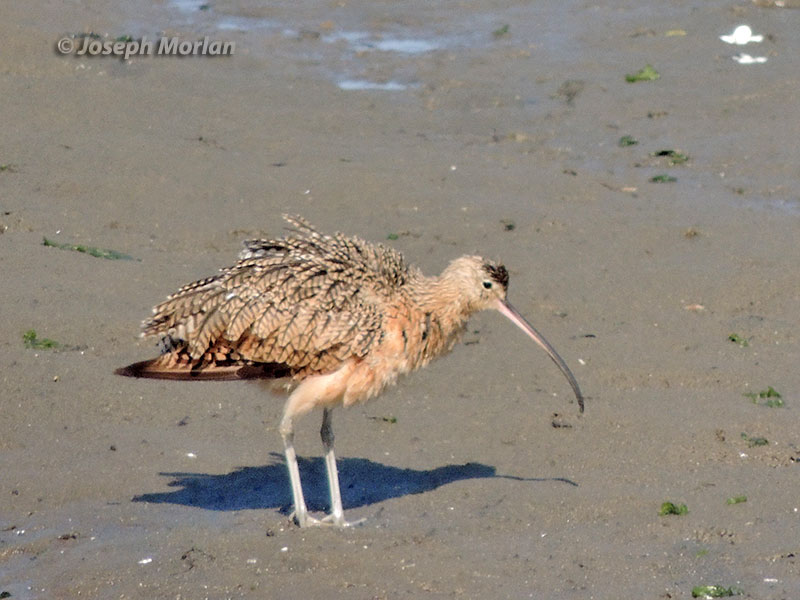
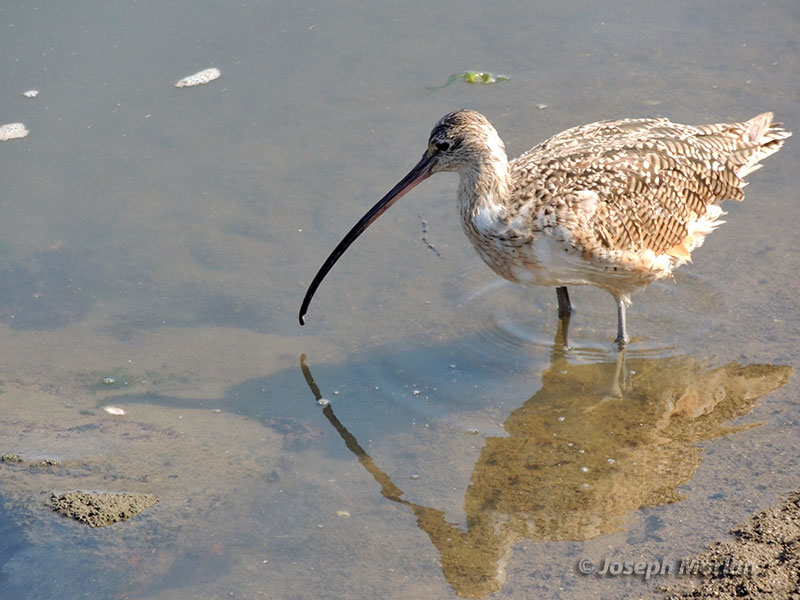
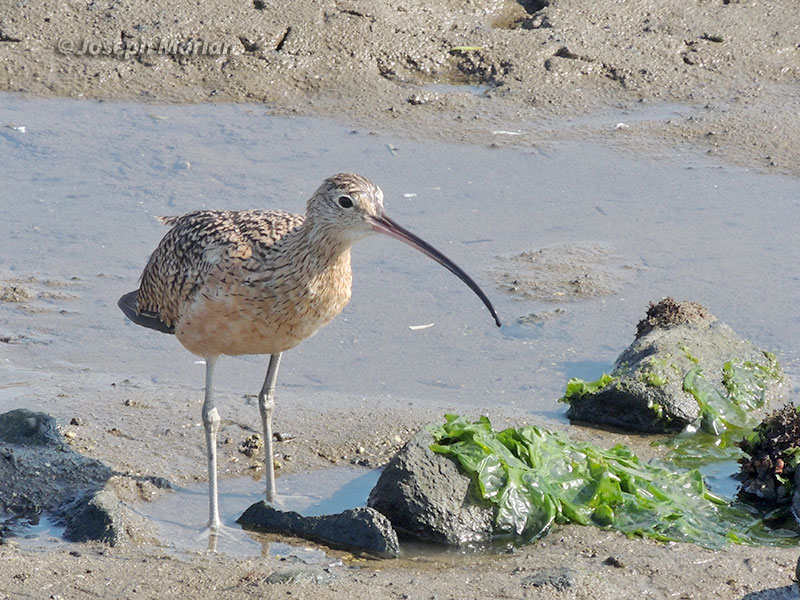
This is the largest North American shorebird. It is largely a grassland species breeding in the western plains and wintering primarily in Mexico. However it is not uncommon in the valleys and coasts of California in migration and in the winter. These birds are highly skilled at manipulating small invertebrates which they find by probing in the mud or damp soil. They apparently use their long tongue to maneuver small morsels from the tip of the bill into their mouths. I have watched them swallowing small snails whole, and the way they guide prey along their long curved bill and into their mouths is remarkable. Two subspecies are normally recognized. A smaller, shorter billed race, N. a. parvus in the north and west and a larger, longer billed nominate race in the southern plains. However, Dugger & Dugger consider the validity of these races to be doubtful, and the race wintering in California has never been determined. Nikon CoolPix P510.
References:
Chandler, R. (2009). Shorebirds of North America, Europe, and Asia: A photographic guide. Princeton Univ. Press.
Dugger, B. D. and K. M. Dugger (2002). Long-billed Curlew (Numenius americanus), version 2.0. In The Birds of North America (A. F. Poole and F. B. Gill, Editors). Cornell Lab of Ornithology, Ithaca, NY, USA. https://doi.org/10.2173/bna.628
Van Gils, J., Wiersma, P. & Kirwan, G.M. (2018). Long-billed Curlew (Numenius americanus). In: del Hoyo, J., Elliott, A., Sargatal, J., Christie, D.A. & de Juana, E. (eds.). Handbook of the Birds of the World Alive. Lynx Edicions, Barcelona. (retrieved from https://www.hbw.com/node/53899 on 24 October 2018).