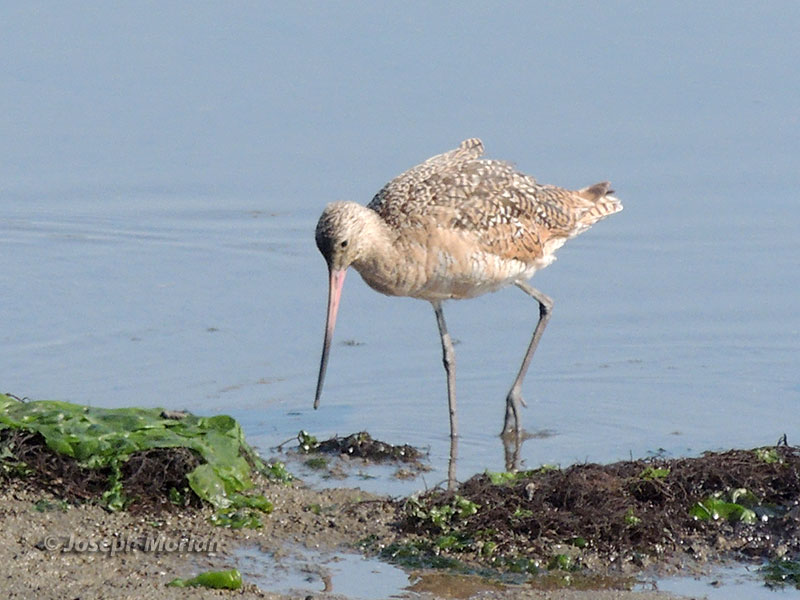
Marbled Godwits are common migrants and winter visitors to our shores from breeding grounds in the interior of Canada and the northern prairies of the US. They look very similar year round, but the dark bars on the underparts of this individual indicate it is an adult molting into winter plumage. The long bill has a prehensile tip for grabbing worms deep in the mud.
There are four godwits in the genus Limosa. The Marbled Godwit is the largest of the four. Two subspecies are recognized differing in size. This is probably the widespread nominate race L. f. fedoa. A rare smaller race, L. f. beringiae, breeds locally in Alaska and is believed to winter along the coast as far south of Northern California, but its status here is not certain. The two races overlap in weight. DNA evidence suggests that godwits are most closely related to curlews. The strong similarity in plumage between the Marbled Godwit and the Long-billed Curlew supports that classification.
Nikon CoolPix P510.
References:
Chandler, R. (2009). Shorebirds of North America, Europe, and Asia: A photographic guide. Princeton Univ. Press.
Gratto-Trevor, C. L. (2000). Marbled Godwit (Limosa fedoa), version 2.0. In The Birds of North America (A. F. Poole and F. B. Gill, Editors). Cornell Lab of Ornithology, Ithaca, NY, USA. https://doi.org/10.2173/bna.492
Van Gils, J., Wiersma, P., Kirwan, G.M. & Sharpe, C.J. (2018). Marbled Godwit (Limosa fedoa). In: del Hoyo, J., Elliott, A., Sargatal, J., Christie, D.A. & de Juana, E. (eds.). Handbook of the Birds of the World Alive. Lynx Edicions, Barcelona. (retrieved from https://www.hbw.com/node/53891 on 23 October 2018).