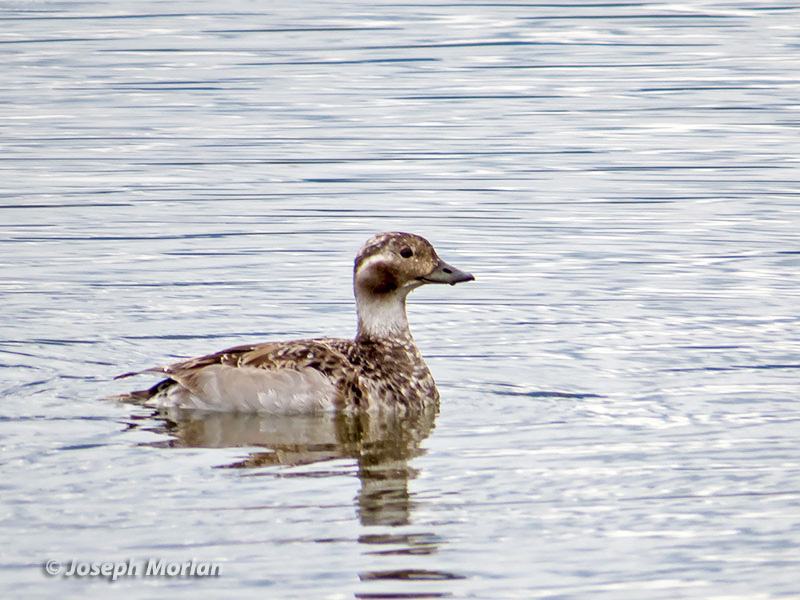
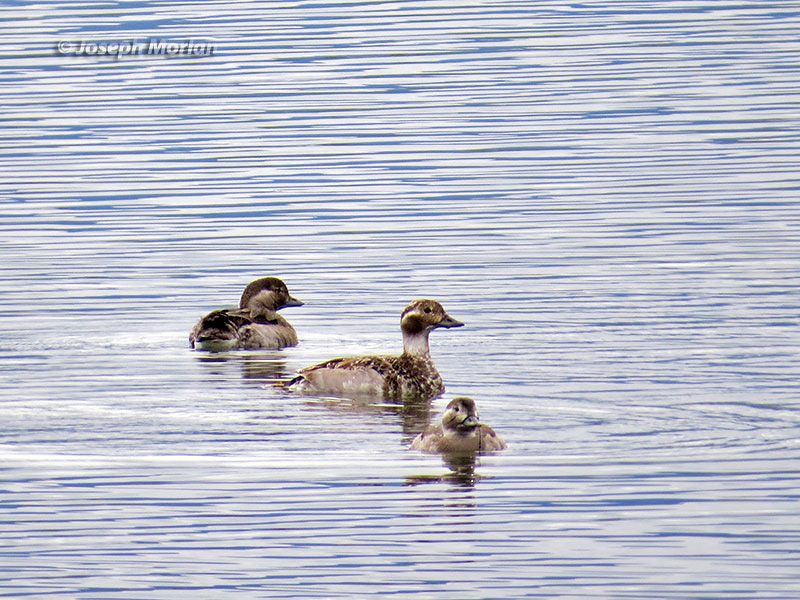
Formerly known as Oldsquaw. This is a female in breeding plumage. This species is listed as "vulnerable" by IUCN based on data from the Baltic Sea, where the species shows significant wintering declines since the early 1990s. This species has a complex series of plumages that is often explained by invoking a presupplemental molt. Males have two different "ornamental" plumages and a so-called "eclipse" plumage. However Pyle (2008) and Howell (2010) both question the existence of a supplemental plumage in this species. The three apparent plumage aspects can better be explained by overlapping prebasic and prealternate molts. Bottom photo shows two chicks. Canon SX50 HS PowerShot.
References:
BirdLife International. 2018. Clangula hyemalis (amended version of 2017 assessment). The IUCN Red List of Threatened Species 2018: e.T22680427A122303234. Downloaded on 11 September 2018.
Carboneras, C. & Kirwan, G.M. (2018). Long-tailed Duck (Clangula hyemalis). In: del Hoyo, J., Elliott, A., Sargatal, J., Christie, D.A. & de Juana, E. (eds.). Handbook of the Birds of the World Alive. Lynx Edicions, Barcelona. (retrieved from https://www.hbw.com/node/52919 on 11 September 2018).
Howell, S. N. G. (2010) Molt in North American Birds. Houghton Mifflin Harcourt, Boston & New York.
Morlan, J. (2009). What, if anything, is "eclipse" plumage. Birding 41(6):50-52.
Pyle, P. (2008) Identification Guide to North American Birds - Part II. Slate Creek Press, Point Reyes Station, California.
Robertson, G. J. and J. L. Savard (2002). Long-tailed Duck (Clangula hyemalis), version 2.0. In The Birds of North America (A. F. Poole and F. B. Gill, Editors). Cornell Lab of Ornithology, Ithaca, NY, USA. https://doi.org/10.2173/bna.651
Todd, F. S. (1979) Waterfowl - Ducks, Geese & Swans of the World. Harcourt Brace Jovanovich, New York & London.