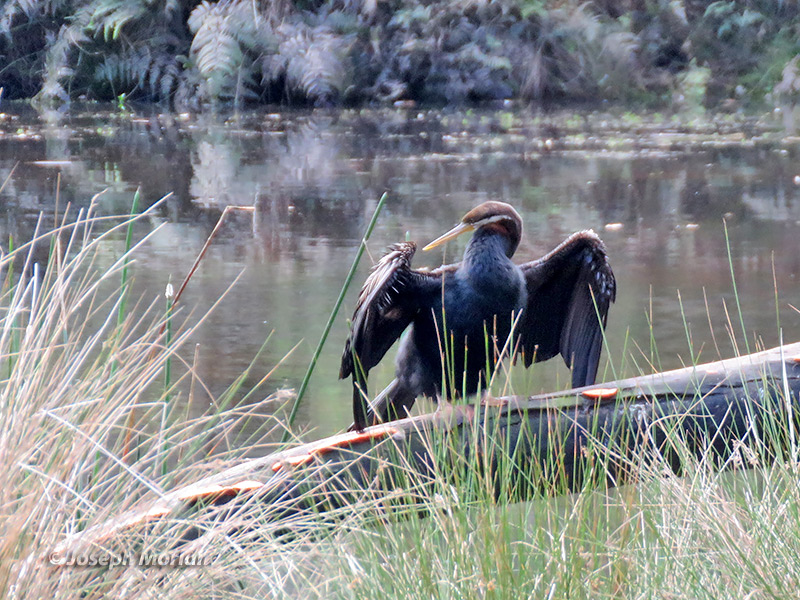
I believe this is an adult male showing chestnut on its fore-neck. Note the wispy down-like body feather structures
which are raised when sunning to help dry the feathers down to the base as seen here. These structures allow the
absorption of water into their plumage. The number of species included in the genus varies between two and four
depending on the authority. Based on a 2012 study by Schodde et al. most recent authorities recognize four
species as follows:
- Anhinga (Anhinga anhinga)
- African Darter (Anhinga rufa)
- Oriental Darter (Anhinga melanogaster)
- Australasian Darter (Anhinga novaehollandiae)
All darters forage by swimming partially submerged using their sharp bill to spear fish. When under water they
can control the amount of air in their subcutaneous air-sacs by partially spreading their wings. As adults their
nostrils are fused shut and their tongue is just a stub. Canon PowerShot SX60 HS.
References:
del Hoyo, J., Collar, N. & Garcia, E.F.J. (2020). Australasian Darter (Anhinga novaehollandiae). In: del Hoyo, J., Elliott, A., Sargatal, J., Christie, D.A. & de Juana, E. (eds.). Handbook of the Birds of the World Alive. Lynx Edicions, Barcelona. (retrieved from https://www.hbw.com/node/467296 on 3 January 2020).
Marchant, S.; Higgins, P.J. (eds.) 1990. Handbook of Australian, New Zealand and Antarctic birds. Vol. 1, ratites to ducks. Oxford University Press: Melbourne.
Sagar, P.M. 2013. Darter. In Miskelly, C.M. (ed.) New Zealand Birds Online. www.nzbirdsonline.org.nz
Schodde, R., Kirwan, G.M. and Porter, R. (2012). Morphological differentiation and speciation among darters (Anhinga). Bulletin British Ornithologists' Club 4: 283-294