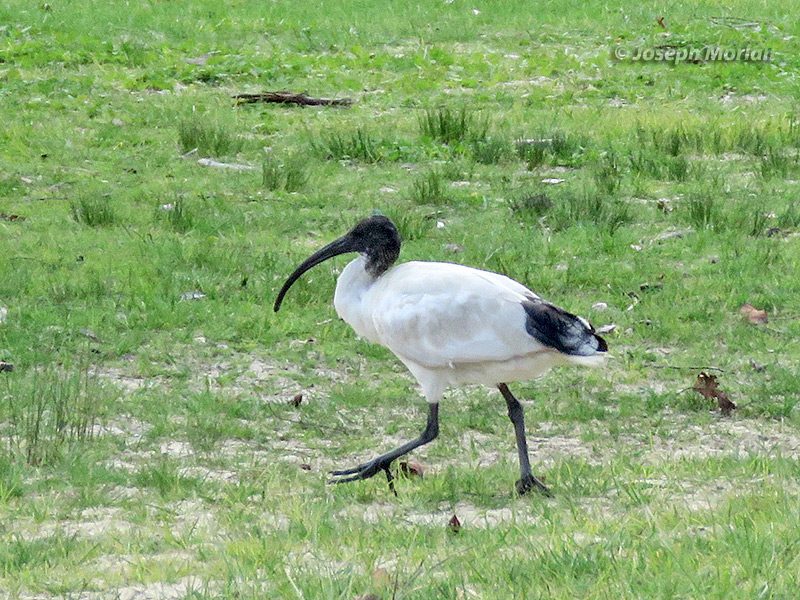
The blended neck pattern indicates this is an immature. This common wader often goes by the name Australian White Ibis (e.g. IOC). Historically it was treated as a race of the Sacred Ibis (T. aethiopicus). However genetic studies have shown that they have different chromosome karyotypes. Australian Ibis has changed its habits over recent decades. It has expanded from pristine marshes and moved into urban areas where it forages in rubbish bins and dumpsters. The scientific name has been spelled moluccus for gender agreement but reverted to the original molucca because it's a noun in apposition and not an adjective (Schodde & Bock, 2016). Canon PowerShot SX60 HS.
References:
de Boer L. E. M., van Brink J. M. (1982) Cytotaxonomy of the Ciconiiformes (Aves), with karyotypes of eight species new to cytology. Cytogenet Genome Res 34:19-34.
Lowe, K. W.; Richards, G. C. (1991). Morphological Variation in the Sacred Ibis Threskiornis aethiopicus Superspecies Complex (PDF). Emu. 91 (1): 41-45. doi:10.1071/MU9910041. Retrieved 11 July 2018.
Marchant, S.; Higgins, P.J. 1990. Handbook of Australian, New Zealand and Antarctic birds. Volume 1. Australian pelican to ducks. Oxford University Press, Melbourne.
Matheu, E., del Hoyo, J., Garcia, E.F.J. & Boesman, P. (2019). Australian Ibis (Threskiornis moluccus). In: del Hoyo, J., Elliott, A., Sargatal, J., Christie, D.A. & de Juana, E. (eds.). Handbook of the Birds of the World Alive. Lynx Edicions, Barcelona. (retrieved from https://www.hbw.com/node/52755 on 30 December 2019).
Schodde, R. & Bock, W. 2016. Conflict resolution of grammar and gender for avian species-group names under Article 31.2.2 of the ICZN Code: is gender agreement worth it? Zootaxa 4127: 161-170.
Southey, I. 2013. White ibis. In Miskelly, C.M. (ed.) New Zealand Birds Online. www.nzbirdsonline.org.nz