Ornithology IIIB Calendar
If you miss a class, please check this page and study the listed topics in your field
guide. For Field Trips, click here.
December 10
We completed and reviewed the Donwy, Hairy, Three-toed, and Black-backed woodpeckers on page 270. Next week
is the last class. The spring schedule is here. Please preregister if possible. Thank
you.
December 5
We added three species to our cumulative class list for the Palo Alto high tide trip, Brown Pelican, Wood Duck,
and Say's Phoebe. The Brown Pelican was seen flying high to the south over the duck pond and the Wood Duck was
on the duck pond and the Say's Phoebe flew over the marsh near the airport..
Another highlight was the adult Greater White-fronted Goose on the pond which arrived last year as an immature
and never left. Young wild geese need their clan to learn migration and may not migrate normally if they get lost
as this bird did. The consensus among the locals is that the Wood Duck is probably a released bird and not countable
as wild. It arrived late last spring in a very disheveled condition.
We did not try for Black Rail as there was too big a crowd. Nevertheless it was a good trip and the weather was
great. The full list is at
http://fog.ccsf.edu/~jmorlan/PALO.html .
December 3
We completed and reviewed Williamson's, Red-breasted, Yellow-bellied and Red-naped sapsuckers on page 268. Remember
the Palo Alto Field Trip meets at 11am on December 5th.
November 19
We completed and reviewed Red-headed, Acorn, White-headed and Lewis's woodpeckers on page 266. No class next
week. Next class will be December 3rd. Have a great holiday!
November 14
We added three new species to our cumulative list since 1985: Great Egret, Steller's Jay and Hermit Warbler.
The Egret was at the main arboretum pond. We had several Steller's Jays including 1-2 around the Lily Pond in the
Rhododendron Dell, one flying over toward the arboretum across the street from the Academy and one (same?) in the
Arboretum itself. The Hermit Warbler was a dull female foraging in a Norfolk Pine adjacent to the rest rooms by
the ballfield across from the Academy.
Other birds of interest were three Acorn Woodpeckers by the Lily Pond and a gull that, for now, I'm calling
a very pale 1st winter Thayer's Gull on the main pond at Strybing. It's wingtips were very slightly darker than
the rest of the bird, with narrow pale fringing. Tertials were mostly solid at the base but with pale fringing
and several of the upper tertials had a few pale internal loops. The tail was fairly solid with some pale fringing
at the tip, but no obvious vermiculations across the middle. The bill was very interesting. It was shaped like
a Thayer's but had a faint pinkish coloration to the basal 2/3rds. This is incorrect for Thayer's. The back was
paler than most Thayer's with the mantle feathers having about equal amounts of light and dark.
A case can be made that this bird is similar to some Iceland Gulls, but there is probably not enough to claim
it as such in California. The bill coloration is good Iceland, but the bill is bit too long and better for Thayer's
in size. The tertial pattern is ok for either. The tail is apparently ok for either, but favors Thayer's. The wing-tips
are ok for either, but probably favor Thayer's. So if you want to claim an Iceland based on the bill coloration
combined with a bunch of ambiguous characters which might be ok for Iceland, now's your chance.
My best guess is that it is probably a Thayer's x Iceland intergrade. The bird can be approached closely and
photographs would make great conversation if nothing else.
The full trip list can be viewed here.
November 12
We completed and reviewed Golden-fronted, Red-bellied & Gila woodpeckers and Northern and Guilded flickers
on page 264. Guilded Flickers mey be distinguished from intergrade Yellow-shafted x Red-shafted flickers by the
Gila's more extensive black on the underside of the tail, more oblong ventral spots, paler coloration and overall
smaller size.
November 5
We completed and reviewed Belted, Ringed and Green Kingfishers on page 262 and did a recap on Selasphorus
hummingbirds. Two hummingbirds from class comprise this month's mystery birds. Click here
to see them and then check out the public comments here.
October 31
This morning's class field trip to Lake Merced had nice weather but the number of ducks and herons was way down.
I think there may be a problem with water quality, especially at the north end. Highlights were an Osprey fishing
at the north end and super views of immature Thayer's, Herring, and Glaucous-winged X Western hybrids from the
bridge at the south end. This is a terrific spot to study immature gulls. We only added one new bird to our composite
list, a tan-striped White-throated Sparrow at the edge of the NE end of the golf course. It was under the tree
that the osprey likes to roost on. The cat colonies by the golf course are going strong and I think the cat people
are also putting out bird seed in the area. I suspect the cats have wiped out the California Quail that used to
inhabit the hedges around the golf course.
The full list is online here.
October 29
We completed and reviewed Broad-tailed, Rufous and Allen's hummingbirds on page 260. Many Rufous Hummingbirds
have green backs and are indistinguishable from Allen's Hummingbirds. Allen's is restricted to coastal California
and is generally absent from Northern California after the end of August. Identification of either species outside
normal season or range is not advised unless the bird is in hand. The most detailed information is in "Birding"
(pgs 18-29) Vol. XXIX: No. 1, 1/97 by Heidcamp. However note the information in "Table 2" should be used
with great caution.
October 22
We completed and reviewed Black-chinned, Costa's and Anna's hummingbirds on page 258 and started Calliope Hummingbird
on page 260. Female Archilochus hummingbirds do not show the white supraloral stripe evident in female Calypte
hummingbirds. Female Ruby-throats have a shorter bill, greener crown and narrower outer primaries compared to female
Black-chinned. An excellent additional source of information is here
where you can see why this year's probably Ruby-throat in Kern County was actually a Black-chinned. Female Costa's
are grayer above, whiter below and longer-billed than female Anna's. Calypte is the only hummingbird genus
in which the birds habitually sing from a perch.
October 17
The field trip to Point Reyes started with good views of Great-horned and Barn owls at Drake's Beach.
At Mendoza Ranch we were rewarded with fine views of two Palm Warblers. We also got to study an immature
Ferruginous Hawk and saw four Pacific Golden-Plovers at the Spaletta Plateau. Just before lunch we were treated
to a soaring Peregrine Falcon. After lunch several of us spent time walking in a recently plowed field and
eventually we saw close scope views of both Lapland and Chestnut-collared longspurs. Thanks to all who came.
It was a great trip! The full bird list is here.
October 15
We completed and reviewed Blue-throated, and Magnificent Hummingbird on page 256 and started Ruby-throated and
Black-chinned Hummingbird on page 258. Next week is the last class of the quarter. Please preregister for the
next quarter if possible. The field trip to Point Reyes is this Saturday. I hope to see you there!
October 10
The trip list for the Chain of Lakes has been marked with the birds we saw including
five species new species not seen on past fall trips at this site. We added Eared Grebe, Herring Gull, Hairy Woodpecker,
Steller's Jay and Black-headed Grosbeak to the composite list. It was an excellent trip with lots of very cooperative
birds. The Steller's Jay was particularly unexpected.
October 8
We completed the hummingbirds on page 254 and just got through Broad-billed, White-eared and Violet-crowned
hummingbirds on page 256. We discussed the efficacy of red dye in hummingbird food. There is no evidence that it
is either harmful or safe, but it is unnecessary and I recommend not using it. The best mixture is 1 part refined
white sugar to 4 parts water. Boil and cool.
October 1
We finished and reviewed the nighthawks on page 250 and completed the swifts on page 252.
September 28
We finished and reviewed Northern Hawk-Owl, Northern Saw-whet, Boreal & Burrowing owls on page 246 and Chuck-will's-widow,
Whip-poor-will, Buff-collared Nightjar and Common Poorwill on page 248. This was a scheduled make-up class. We
also reviewed birds seen on Saturday's field trip. For more details see the September 26th entry here.
September 24
We finished and reviewed Flammulated and Elf owls and Ferruginous and Northern pygmy-owls on page 244. The make
up class has been scheduled for Monday September 28th in the same room.
A field trip to Rodeo Lagoon will be this Saturday. The bird list is here.
September 17
We finished and reviewed Eastern, Western and Whiskered screech-owls on page 242 with reference to the screech-owl
chapter in Kaufmann's "Advanced
Birding."
For reference, the Ornithology III a and b calendar summary from last semester is below:
May 28
We finished and reviewed Barred, Great Gray, Spotted and Snowy owls on page 240. Highlights of the Briones Field
Trip last Saturday are here. The last field trip will be June
6th at Point Reyes, Drake's Beach at 9am. Hope for overcast skies and calm winds. Bring lunch and be prepared for
possible cold and blustery conditions. I hope to see you all there. If not, have a great summer. Classes will continue
starting September 10th. Fees will be $90. Please preregister after July 1st.. Click here
for information.
May 21
This Saturday, May 23rd, there will be a field trip to Briones Regional Park. Click here
for information.
Sunday's trip to Alviso was excellent. About 10:30 we found the immatureLittle Gull on
the narrow
island with Forster's Terns. We got good scope views until the bird flew over to the pond to the east (A18?) after
which we could not find it. About 11:30 an adult Little Blue Heron flew over New Chicago Marsh while we were exploring
the boardwalk. It disappeared behind the levee to the north. We had two flyover Cattle Egret sightings possibly
of the same bird flying back and forth between Arzino Ranch and the heronry. Landbird migrants included several
Western Kingbirds, Bullock's Orioles, a Western Tanager, Swainson's Thrush, Yellow Warblers, Wilson's Warblers,
Warbling Vireo and Western Wood-Pewee. Most of these species are not on the checklist posted at the center. Another
highlight was a brood of baby Avocets.
An account with captures from the video and video of the Kehoe Beach Bristle-thighed Culrew are posted on my website
here.
We finished and reviewed Barn, Short-eared, Long-eared and Great Horned owls on on page 238. Next week is the
last evening class of the semester.
May 14
This Sunday's Field Trip will meet at the Environmental Education Center in Alviso, Santa Clara County. Take
Hwy. 101 south to Mountain View and go east on Hwy. 237. Go north on North First Street and turn right on Grand
Blvd. When you get to the intersection of Los Esteros Road, bear slightly left onto the entrance road to the center.
Meet at the parking lot at 9am. The gate will be opened early for us. Click here
for a map and alternate directions if you are coming from the East Bay.
We completed and reviewed Black-billed Cuckoo and Greater Roadrunner on page 236 and started owls on page 238.
May 7
We completed parrots, trogons, cuckoos and anis on pages 230-234 and Mangrove & Yellow-billed cuckoos on
page 236. For details on the feral parrots in San Francisco click here.
Requests for the field trip on May 17th are welcome. Send me email if you have a suggestions. Remember that's
"Bay to Breakers" day.
May 3
Today's field trip to northeast Contra Costa County started at Piper Slough at the north end of Bethel Island
Road. Black-chinned Hummingbirds put on a great show and we had excellent views of Blue Grosbeaks and Yellow-breasted
Chats, the latter doing song-flights. These were around the bend along the levee to the west. We only saw one pair
of Hooded Orioles near the first house but quite a few Bullock's Orioles were in the neighborhood.
Back down Bethel Island Road the traffic from a free dump day was seriously disturbing a Loggerhead Shrike nest.
Not much we could do about the constant stream of traffic there.
On Jersey Island Road we found a Swainson's Hawk sitting on a nest at the top of a tall cottonwood on the west
side about half way between Dutch Slough and Cypress Road. The nest is across an open field surrounded by trees
and just north of the only house on the road. This is the same area where George Griffeth had a pair of Swainson's
Hawks copulating a week ago Friday. A few Long-billed Curlew were in the flooded field on the east side.
Then we checked Delta Road east of Knightsen finding a Great Horned Owl sitting in a cottonwood behind an abandoned
shack just south of the Rock Slough Bridge. At the Holland Tract we serendipitously got invited into the private
property at the west end of the Rock Slough Bridge and walked over to the tall cottonwood where Steve Glover had
reported a Swainson's Hawk nest back in March. The hawk was still on the nest sitting tight. We could only see
the nest and the hawk when we were almost under the tree. It was interesting looking through a scope straight into
the nostrils of a Swainson's Hawk. This nest was not visible from the bridge or public road. Perhaps the tree had
not yet completely leafed out when Steve found this nest. In the distance three Western Kingbirds were harassing
a Raven on a pylon.
Very few migrants were seen, but it was a good day.
April 30
This Sunday's Field Trip will be at Bethel Island in Eastern Contra Costa County. From Concord, take Hwy 4 East;
continue east (right) on Hwy 4 through Oakley. About a mile past Oakley, turn left on Cypress Road. Continue east
on Cypress about 4 miles all the way to the end. Turn left and continue north on Bethel Island Road across the
bridge, past the town of Bethel Island all the way to the end. Park along West Willow Road on the right. There
are no facilities whatsoever here. The closest public restrooms are at the golf course on Gateway Road just north
of the town of Bethel Island. Travel time about 1¼ hour. Meet at 8:30am. Click here
for a map.
We completed and reviewed Common and Ruddy ground-doves, Inca and White-tipped doves, and Ruddy and Key West
quail-doves on page 228 and began parrots on page 230.
April 23
We completed and reviewed Band-tailed, Red-billed, and White-crowned pigeons and Rock Dove on page 224 and Mourning,
Zenaida, White-winged, Collared and Spotted dove and Ringed Turtle-Dove on page 226. Ringed Turtle-Dove is a domestic
variety of the African Barbary Dove and does not occur wild anywhere in the world. It has been removed from the
North American Check-List and replaced by the abundant Collared Dove which has spread as far west as Colorado and
shows no sign of slowing its range expansion worldwide.
Highlights of the Mount Diablo Field trip were Calliope Hummingbird, and several Hammond's Flycatchers. We also
saw Nashville Warblers, Western Tanagers, Lazuli Buntings, Purple Finches, Hairy Woodpeckers, etc.
Saturday Field Trips are now available to all classes. Click here for a list of trips
and here for lists of birds.
April 15
A field trip to Mount Diablo will meet at 8:30am this Sunday, April 19th at the south end of Mitchell Canyon
Road near Clayton, Contra Costa County. A $3 toll gate into the parking lot at the end of the road requires exact
change. From Walnut Creek, take Ygnacio Valley Road east to Clayton Road. Turn right on Marsh Creek Road then right
on Mitchell Canyon all the way to the end. Click here for a general
map. Travel time is about one hour from San Francisco. We will explore the Mitchell Canyon and Back Point Trails,
returning to the parking lot for lunch. Click here for a map
with links to more details on the trails including photos and video. A brief article on chaparral birds is at http://www.mdia.org/birdschap.htm.
We completed and reviewed Gray Partridge & Himalyan Snowcock on page 220 and Ring-necked Pheasant, Wild
Turkey & Plain Chachalaca on page 222. We also began the pigeons and doves on page 224 with a discussion of
distribution and geographic variation in the Band-tailed Pigeon and discussed how to discourage them from bird
feeders.
April 5
Highlights of the Pescadero trip included nice close views of large numbers of Surfbirds and several Black Oystercatchers
along the rocks. A male Black Scoter was offshore and a gray whale spouted several times. We walked across the
bridge to check the shorebirds in the North Pond where we found at least two Lesser Yellowlegs. My plans to check
the headquarters at the end of Water Lane were thwarted by the still-flooded fire road. However we did enjoy many
landbirds in the area including a Lincoln's Sparrow and a male Rufous Hummingbird while we had lunch. Several of
us explored Waddell Creek in the afternoon under pleasant balmy conditions, but failed to find the hoped-for Northern
Pygmy Owl.
April 2
A field trip will meet this Sunday, April 5th at 9am Pacific Daylight Time at Pescadero Beach. Meet at
the parking lot on the west side of Highway 1 across from Pescadero Road. Please remember to set your clocks ahead
the night before. The meeting time is thus equivalent to 8am, Pacific Standard Time. Travel time from San Francisco
is about one hour. Click here for a map.
We completed pages 216 and 218; Northern Bobwhite, Montezuma, Scaled, Gambel's California & Mountain quail.
We also covered the Chukar on page 220.
March 26
We completed pages 212 and 214; White-tailed, Rock and Willow ptarmigan; and Greater & Lesser prairie-chickens,
and Sharp-tailed & Sage grouse.
Next week is the last class for the quarter. Please pre-register for the second session which starts April 16th.
March 22
This was the first time I took a group to Del Valle, a large reservoir south of Livermore. We had a congenial
group of 10 students but clouds were threatening and just as the trip started, it began raining in ernest. Very
inauspicious.
Swallows were flying around the docks affording great looks a Barn and Rough-winged. A fine male Osprey was perched
on the opposite shore. As we started for the trail, I heard the Osprey calling loudly and looked up to watch an
adult Bald Eagle chasing the Osprey out over the lake. The two circled around until the Eagle won the battle, fully
intimidating the smaller Osprey and chasing it off. The Eagle then disappeared up to the north end of the lake
as the rain stopped and the sky started clearing.
I wondered what I could do for a finale :). The rain let up and we watched Cliff Swallows building a new colony
on a closed off outhouse. Taking the trail to the north we heard Rufous-crowned Sparrows calling and singing and
eventually got spectacular scope views of these shy birds. Meanwhile I kept hearing Belted Kingfishers across the
lake. Eventually we found a pair excavating a nesting hole at the top of a sheltered embankment on the far shore.
Through scopes we could see the male working on the hole while the female perched on an exposed root below the
nest. Dirt was flying as the male kingfisher pecked out the hole.
Arriving at the Hetch Hetchy Picnic Area the adult Bald Eagle was perched in the open near the top of a large Gray
Pine across the lake. In a nearby tree we could see the nest, with just a glimpse of another adult eagle apparently
incubating. Meanwhile, an adult Golden Eagle glided over the ridges at a distance. Two brilliant newly arrived
Bullock's Orioles displayed in an open tree and a flock of about a half dozen Phainopeplas showed off around the
mistletoe. The weather became balmy as we headed up the hill to get a closer look at the Western Bluebirds and
a better vantage looking down into the eagle's nest. Now we could see the whole head and bill of the incubating
bird.
On the way back an immature Golden Eagle flew very low over our group, quickly gaining altitude and then cruising
low below the radar of the ubiquitous ground squirrels finally disappearing behind the ridge. We didn't see if
it made a kill or not. A White-tailed Kite started calling and flew over us as we returned to the parking area
at the boat launching ramp.
A memorable morning.
March 19
Field Trip will meet at 9am this Sunday, March 22 at the Del Valle Regional Park south
of Livermore. Take I 580 east to Livermore. Go south on North Livermore Avenue which becomes South Livermore Avenue
which becomes Tesla. Make a right on Mines Road and right on Del Valle Road to the entrance kiosk. Pay the fee
and drive to the last parking lot near the boat launching area on the right. Travel time about 1.5 hours. Click
here for map.
We completed page 204 (Gyrfalcon) and reviewed large falcons. We also completed and reviewed page 210 (Ruffed,
Spruce and Blue grouse).
March 12
We completed page 202 and did Prairie Falcon & Peregrine Falcon on page 204. We discussed the three subspecies
of Merlin and of Peregrine. We also discussed the Peregrine recovery program. Next week, we will begin with Gryfalcon
followed by a raptor review and then move on to grouse.
March 8
We had a wonderful trip to Pt. Reyes this morning. The White-tailed Kite put on a great show over Olema Marsh;
the Ospreys were carrying nesting material into a nest right by the road at Limantour while an adult Golden Eagle
flew over. At the beach we found Marbled Murrelet and Red-necked Grebe as well as big flocks of Brant.
After lunch a few of us went to Bolinas Lagoon where we found the adult male Tufted Duck, Eurasian Wigeon and a
Rufous-crowned Sparrow. But the best part was the great weather.
March 5
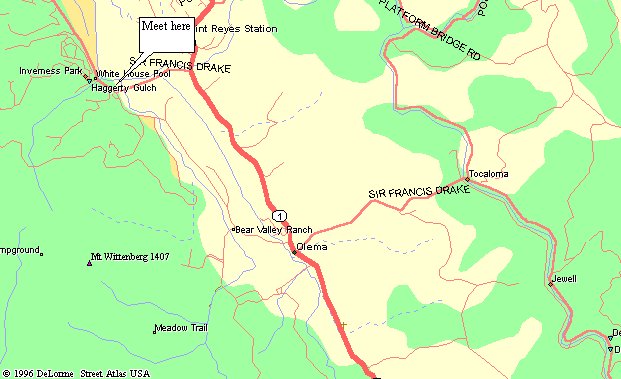
Field Trip will meet at 9am this Sunday, March 8 at the White House Pool public fishing
access across from the NW corner of Olema Marsh. Click here for map.
We completed pages 198-200, Harris' Hawk - Crested Caracara. Bob Ball showed a video of cooperative hunting
in the Harris' Hawk. Short-tailed Hawk is unique in that it completes its post juvenal molt much earlier than other
hawks. Birds seen from late fall on are already in adult plumage.
February 26
We completed page 196, Rough-legged Hawk, Ferruginous Hawk & White-tailed Hawk. Note upperwing pattern
of all ages of Ferruginous Hawk has white including the bases of the secondaries as well as the primaries.
The plate fails to show this. Dark morph of Ferruginous Hawk is not shown. Closely resembles Harlan's
race of Red-tailed Hawk but has white patches at bases of primaries and secondaries on upperside of wing.
Harlan's lacks this pattern.
On page 198 we covered Common Black-Hawk and most of Harris' Hawk. Next week we will start with the appearance
of Harris' Hawk in flight and there is a possibility we will have a video showing cooperative hunting in Harris'
Hawk. We discussed the demise of Harris' Hawk in Southern California followed by its recent incursion there.
February 19
We completed page 194, Red-tailed and Swainson's Hawk. Note the dark breast-band shown on the perched Red-tailed
Hawk is misleading and incorrect. Suggest whitening it out.
The following two photos from the quiz were questionable:
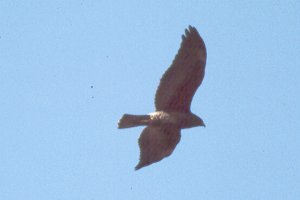 I incorrectly identified
this as a Swainson's Hawk although Jim Best pointed out the dark wing coverts seemed to contrast with paler remiges.
I argued for Swainson's based on photo SH07 on page 66 of Wheeler & Clark. I have since enhanced the image
reproduced here and we can now see that the remiges are uniformly pale, lacking the dark trailing edge of Swainson's
and the wing also shows an extensive secondary bulge on the trailing edge of the wing consistent with White-tailed
Hawk.. See photo WT06 on page 75 of Wheeler & Clark. I am now confident this bird was actually a juvenile White-tailed
Hawk.
I incorrectly identified
this as a Swainson's Hawk although Jim Best pointed out the dark wing coverts seemed to contrast with paler remiges.
I argued for Swainson's based on photo SH07 on page 66 of Wheeler & Clark. I have since enhanced the image
reproduced here and we can now see that the remiges are uniformly pale, lacking the dark trailing edge of Swainson's
and the wing also shows an extensive secondary bulge on the trailing edge of the wing consistent with White-tailed
Hawk.. See photo WT06 on page 75 of Wheeler & Clark. I am now confident this bird was actually a juvenile White-tailed
Hawk.
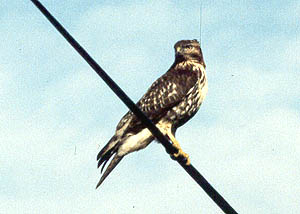 I identified this
bird as a possible Broad-winged Hawk based on its apparent small size, slim shape and reasonably patterned head.
The slide is labeled Red-tailed Hawk by the photographer. Note that the wing-tips reach only slightly beyond the
center of the tail. On juvenile Red-tailed Hawk the wing-tips should reach almost to the tail tip. Cf. plate 10
and 11 in Clark & Wheeler. Thus I still think it is probably a Broad-wing.
I identified this
bird as a possible Broad-winged Hawk based on its apparent small size, slim shape and reasonably patterned head.
The slide is labeled Red-tailed Hawk by the photographer. Note that the wing-tips reach only slightly beyond the
center of the tail. On juvenile Red-tailed Hawk the wing-tips should reach almost to the tail tip. Cf. plate 10
and 11 in Clark & Wheeler. Thus I still think it is probably a Broad-wing.
Note: This became a quiz bird for the month of March and it may well be a Red-tailed Hawk after all. Click
here for more discussion.