FOUR ON THE FLOOR
The image below is a photo of the exhibit panel. Following it is a transcript of the panel.
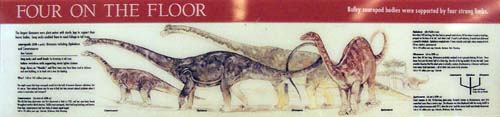
Bulky sauropod bodies were supported by four strong limbs.
The largest dinosaurs were plant-eaters with sturdy legs to support their heavy bodies. Long necks enabled them to reach foliage in tall trees.
sauropods
(
SOR
-o-pods): dinosaurs including
Diplodocus
and
Camarasaurus
New features:
- long necks and small heads for browsing in tall trees
- hollow vertebrae with supporting struts lighten skeleton
- large claws on "thumbs" and first toes may have been used in defense and nest-building, or to hook into a tree for feeding
When? 160 to 145 million years ago
You might expect that large sauropods would form the bulk of museum dinosaur collections, but it's not so. Their colossal bones may be easy to find, but they present colossal problems when it comes to excavation and transport!
Camarasaurus
(ka-mare-ah-
SOR
-us)
This 60-foot-long plant-eater was first discovered in Utah in 1925, and has since been found throughout western North America. Unlike most sauropods, which had long hind legs and shorter front legs,
Camarasaurus
had four limbs of almost equal length.
160 to 145 million years ago; Colorado, Oklahoma, Utah, Wyoming
Diplodocus
(dih-
PLOD
-0-kus)
More than 100 feet long, this titan had an upward reach of over 40 feet when it stood on hind legs, propped on the base of its tail. And what a tail! If used in self-defense, it would have delivered a powerful whiplash.
Diplodocus
weighed only 11 tons; actually quite light, when compared to its 33-ton relative,
Apatosaurus
!
160 to 145 million years ago; Colorado, Oklahoma, Utah, Wyoming
Ultrasaurus
(ul-tra-
SOR
-us)
More than 98 feet long,
Ultrasaurus
probably weighed in at a ground-shaking 90 tons. These bones form just the lower half of a front leg; the rest of the leg wouldn't fit into this hall! Some scientists theorize that this plant-eater is actually a mature
Brachiosaurus
, a dinosaur well-known from many fossil specimens -- all of which may prove to be juveniles.
160 to 145 million years ago; Colorado
Apatosaurus
(uh-pat-o-
SOR
-us)
Fossil remains of this 70-foot-long plant-eater, formerly nown as
Brontosaurus
, were first unearthed more than a century ago. The dinosaur was then displayed (with the wrong skull!) in a New England museum until 1975, when the error (and the correct skull) were finally discovered.
160 to 145 million years ago; Colorado, Oklahoma, Utah, Wyoming
PICTURE CAPTIONS:
- Camarasaurus
- Diplodocus
- Ultrasaurus
- Apatosaurus
- Diagram showing common ancestry and evolution of Camarasaurus , Diplodocus , and Ultrasaurus from organisms with large neck bones and large claw on thumb.
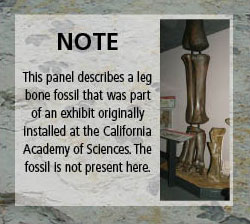
This panel describes a leg bone fossil that was part of an exhibit originally installed at the California Academy of Sciences. The fossil is not present here.