GREEN PLANET
The image below is a photo of the exhibit poster. A text transcript follows.
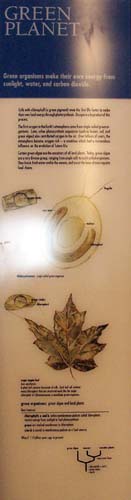
Green organisms make their own energy from sunlight, water, and carbon dioxide.
Cells with chlorophyll (a green pigment) were the first life forms to make their own food energy through photosynthesis. Oxygen is a byproduct of this process.
The first oxygen in the Earth's atmosphere came from single-celled green organisms. Later, other photosynthetic organisms (such as brown, red, and green algae) also contributed oxygen to the air. Over billions of years, the atmosphere became oxygen-rich -- a condition which had a tremendous influence on the evolution of future life.
Certain green algae are the ancestors of all land plants. Today, green algae are a very diverse group, ranging from ginle cells to multi-celled organisms. They live in fresh water and in the oceans, and are at the base of most aquatic food chains.
Green organisms:
green algae and land plants
New features:
- chloropylls a and b, within membranous packets called chloroplasts, receive energy from sunlight to fuel photosynthesis
- Grana are stocked membranes in chloroplasts
- Starch is stored in membranous packets as a food reserve
When? 1.4 billion years ago to present
PICTURE CAPTIONS:
-
Chlamydomonas
-- single-celled green organism
- chloroplast
- nucleus
- eye spot
- grana stacks
- flagella
-
Sugar maple leaf
- chloroplast
- grana stacks
Acer saccharum
A plant leaf contains thousands of cells. Each leaf cell contains many chloroplasts that are structured much like the single chloroplast of Chlamydomonas , a unicellular green organism
- Diagram showing common ancestry and evolution of green algae, mosses, and vascular plants from organisms with chlorophylls a and b, grana stacks, and starch. Evolution of mosses and vascular plants is where waxy outer layer branches off.