HAPPY LANDINGS
The image below is a photo of the exhibit panel. Following it is a transcript of the panel.
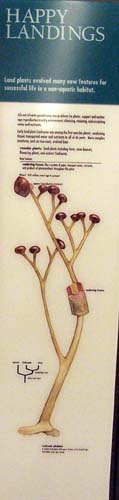
Land plants evolved many new features for successful life in a non-aquatic habitat.
Life out of water posed many new problems for plants: support and anchorage; reproduction in a dry environment; obtaining, retaining, and circulating water and nutrients.
Early land plant
Cooksonia
was among the first vascular plants; conducting tissues transported water and nutrients to all of its parts. More complex structures, such as true roots, evolved later.
vascular plants
: land plants including ferns, cone-bearers, flowering plants, and extinct
Cooksonia
New features:
- conducting tissues , like a system of pipes, transport water, nutrients, and products of photosynthesis throughout the plant
When? 430 million years ago to present
PICTURE CAPTIONS:
- spores (reproductive structures)
- conducting tissues
-
Cooksonia caledonica
A simple land plant with spore clusters at its branch tips.
430 million years ago; Europe - Diagram showing common ancestry and evolution of mosses, Cooksonia , and ferns from organisms with waxy outer layer. Evolution of Cooksonia and ferns is where conducting tissue branches off.