HERE TODAY, GONE TOMORROW
The image below is a photo of the exhibit panel. Following it is a transcript of the panel.
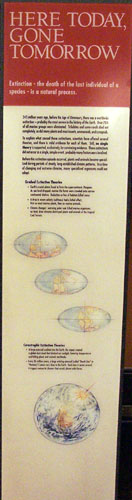
Extinction -- the death of the last individual of a species -- is a natural process.
245 million years ago, before the Age of Dinosaurs, there was a worldwide extinction -- probably the most severe in the history of the Earth. Over 75% of all marine groups were eliminated. Trilobites and some corals died out completely, as did many plants and most insects, ammonoids, and synapsids.
To explain what caused these extinctions, scientists have offered several theories, and there is valid evidence for each of them. Still,
no single theory
is supported, exclusively, by convincing evidence. These extinctions did not occur as a single, simple event; probably many factors were involved.
Before this extinction episode occurred, plants and animals became specialized during periods of steady, long-established climate patterns. In a time of changing and extreme climates, many specialized organisms could not adapt.
Gradual Extinction Theories
- Earth's crustal plates fused to form the supercontinent, Pangaea. As sea level dropped, marine life forms were crowded onto narrow continental shelves. Reduction or loss of habitats killed many.
- A drop in ocean salinity (saltiness) had a lethal effect, first on most marine plants, then on marine animals.
- Climate changes; warming polar seas killed marine organisms; on land, drier climates destroyed plants and animals of the tropical Coal Forests.
Catastrophic Extinction Theories
- A large asteroid crashed into the Earth; the impact created a global dust cloud that blocked out sunlight, lowering temperatures and killing plants and animals worldwide.
- Every 26 million years, a large orbiting asteroid (called "Death Star" or "Nemesis") comes very close to the Earth. Each time it comes around, it triggers meteorite showers that wreak planet-wide havoc.