IF THE SHREW FITS
The image below is a photo of the exhibit panel. Following it is a transcript of the panel.
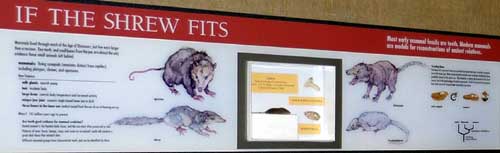
Most early mammal fossils are teeth. Modern mammals are models for reconstructions of ancient relatives.
Mammals lived through much of the Age of Dinosaurs, but few were larger than a raccoon. Tiny teeth, and small bones from the jaw, are almost the only evidence these small animals left behind.
mammals:
living synapsids (amniotes distinct from reptiles), including platypus, shrews, and opossums
New features:
- milk glands nourish young
- hair insulates body
- large brain controls body temperature and increased activity
- unique jaw joint connects single-boned lower jaw to skull
- three bones in the inner ear conduct sound from the ear drum to hearing nerves
When? 145 million years ago to present
- Are teeth good evidence for mammal evolution?
- Dental enamel is the hardest body tissue, and the one most often preserved in rock.
- Patterns of wear, facets, bumps, cusps, and crests on an animal's teeth tell scientists a great deal about that animal's diet.
- Different mammal groups have characteristic teeth, and can be identified by them.
Traveling Bones
The bones of a mammal's inner ear evolved from bones that were, in earlier synapsids, part of the lower jaw. When a new jaw joint evolved, some no-longer-needed jaw bones gradually moved to the inner ear. This transition is clearly documented in the fossil record, and in the embryology of modern mammals. Skulls of some extinct synapsids have both ancestral synapsid and mammalian jaw joints.
PICTURE CAPTIONS:
- opossum
- shrew
- Gobiconodon
- Prozalambdolestes
- early synapsid skull
- mammal skull
- Diagram showing common ancestry and evolution of reptiles, Dimetrodon , and mammals from organisms with amniotic egg and internal fertilization. Evolution of Dimetrodon and mammals is where single opening in skull behind eye branches off.