LAND OF OPPORTUNITY
The image below is a photo of the exhibit panel. Following it is a transcript of the panel.
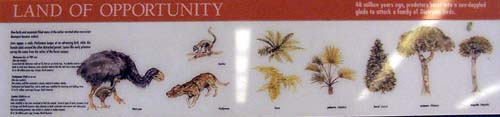
48 million years ago, predators burst into a sun-dappled glade to attack a family of
Diatryma
birds.
New birds and mammals filled many of the niches vacated when non-avian dinosaurs became extinct.
Jaws agape, a male
Pachyaena
lunges at an advancing bird, while the female slinks around the other distracted parent. Lemur-like early primates survey the scene from the safety of the forest canopy.
Diatryma
(dye-ah-
TRY
-ma)
(life size models)
Seven-foot-tall
Diatryma
could not fly, but ran on sturdy legs. It probably used its strong beak to crack nuts; however, some scientists believe that this bird was a meat-eater.
55 to 48 million years ago; Europe, North America
Pachyaena
(
PAK
ee-ee-na)
(life size models)
This extinct, wolf-like mammal is closely related to modern whales.
Pachyaena
had hoofed feet, and its teeth were modified for shearing and holding meat.
57 to 52 million years ago; Europe, North America
Cantius
(
KAN
-tee-us)
(life size models)
Look carefully in the trees overhead to find this animal. Several types of early primates lived in Europe and North America when climates on both continents were warm and subtropical. This fruit-eating primate, now extinct, is related to modern lemurs.
55 to 50 million years ago; Europe, North America
PICTURE CAPTIONS:
- Diatryma
- Cantius
- Pachyaena
- ferns
- palmetto (Sabalites)
- laurel (Laurus)
- sycamore (Platanus)
- magnolia (Magnolia)
This panel describes a true-scale diorama filled with animals, such as the Pachyaena. That diorama was part of an exhibit originally installed at the California Academy of Sciences. It is not present here.