METEORITES
The image below is a photo of the exhibit poster. A text transcript follows.
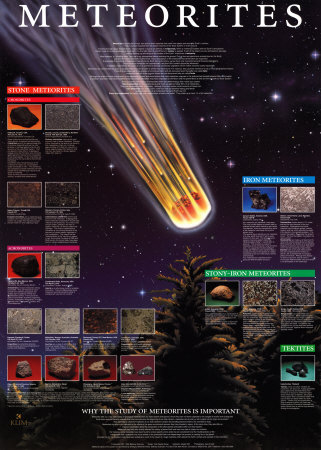
Approximate dimensions: H:44 in W:24 in
KLIM -- Bethany Sciences -- 1996
Design: Cole Design Group; Illustration: Joseph Klim; Photography: Akos Arnold
Meteorites
are particles of rock, iron and/or other materials that come from space and reach the Earth's surface. They may have traveled from the distant reaches of the Solar System or even beyond. Traveling through space towards Earth, natural objects in space are defined as
meteoroids
. When a meteoroid collides with the Earth's atmosphere, friction heats its surface producing a bright light. It is this light effect to which the term
meteor
is applied. If part of the object survives atmospheric passage without burning up and lands on the surface of the Earth, it becomes a
meteorite
Most meteors, or "shooting star," burn up in our atmosphere before reaching the ground. Only a few rare specimens actually land on the Earth and earn the name meteorite. Furthermore, only a tiny portion of the meteorites that fall to Earth are recovered. It is possible that millions of meteorites have struck the Earth during its history, yet we have only recovered several thousand specimens. That's because meteorites fall unpredictably, and their fall is seldom physically witnessed. In addition, most fall into the ocean or onto land that is densely covered by vegetation which makes recovery nearly impossible.
Although the origin of these unique rocks in not absolutely certain, scientists believe that most meteorites originate in the asteroid belt located between Mars and Jupiter. In addition, scientists have recently determined that certain meteorites may have originated on the Moon and the planet Mars as well as from beyond our Solar System.
There are three main classes of meteorites which are determined by their nickel-iron content. Stone meteorites are the largest group and make up approximately 92% of all meteorites. They are comprised chiefly of silicates, although they also contain small amounts of nickel-iron. Iron meteorites are nearly 100% nickel-iron and are therefore heavy and dense. Approximately 7% of all meteorites that fall to Earth are iron. Stony-iron meteorites , the rarest type, are a combination of stone and metal. They make up a mere 1% of all meteorites.
WHY THE STUDY OF METEORITES IS IMPORTANT
Meteorites offer us a very wide variety of geological materials from our Solar System and beyond. Since they have not been subjected to the ravages of erosion and change like Earth rocks and are the only materials that have survived since the beginning of our Solar System, meteorites can provide us with insights into its origin and evolution. They can help to unlock the mysteries of our Solar System's creation by providing physical evidence for scientists to study. Meteorites can give us an indication of the effects of the space environment because they have traveled in space. At the same time, they also offer us important information about the composition of the other planets and bodies within our Solar System. Meteorites may have also directly affected the history of planet Earth and may have had an impact on evolution. For instance, some meteorites have been found to contain specific amino acids that are considered to be the "building blocks of life." It is possible that a meteorite may have landed on the primordial Earth and helped begin the process of creating life on the planet. Ironically, life for the dinosaurs may have been ended as a result of the impact of a huge meteorite which altered the Earth's climate and resulted in their extinction.
STONE METEORITES
CHONDRITES
Stone meteorites are classified into two major groups: chondrites and achondrites.
Chondrites
account for approximately 84% of all stone meteorites and are the most primitive in that they appear to be the only survivors of the early Solar System. Their composition shows little or no geological change since their formation over 4.5 billion years ago and is closest to the composition of pre-solar nebulae. In fact, chondrites are believed to be the raw material that formed the planet.
Chondrites were named because of the existence of unique, tiny, round objects called chondrules in them. The chondrules are composed of silicate materials that have melted and re-solidified and may be found whole or shattered.
There are three classes of chondrites: ordinary, enstatite and carbonaceous.
Image caption: Holbrook, Arizona, USA; Fell July 19, 1912; Olivine-hypersthene chondrite (L6)
Ordinary chondrites make up the most common class of stone meteorites. They are futher classified by the level of iron found in their composition: High-iron, H-Group, approximately 27% total iron; Low-iron, L-Group, approximately 23% total iron; and Low iron, low metal, LL-Group, approximately 20% total iron.
Image caption: Bovedy, County Londonderry, Northern Ireland; Fell April 25, 1969; Olivine-hypersthene chondrite (L3)
Enstatite chondrites are so called because enstatite is the most abundant mineral. They contain less oxygen than the other groups and are metal-rich and magnesium-poor.
Image caption: Happy Canyon, Texas USA; Found 1971; Enstatite chondrite (E6)
Carbonaceous chondrites are the most primitive of all meteorites. It appears that these meteorites condensed in the pre-solar nebulae at low pressures. As a result, they contain carbon, partially in the form of organic molecules, as well as carbon and hydrogen. The study of carbonaceous chondrites is very exciting because of the discovery of certain carbon molecules in their composition. This means that the "building blocks of life" can form in space. In fact, amino acids, the basis of RNA and DNA found in the human body, have been found in certain carbonaceous chondrites.
ACHONDRITES
Achondrites
are stone meteorites without chondrules. They are believed to have formed from planetary processes and display signs of igneous melting and crystallization activity. There are seven types of achondrites: Aubrites; Diogenites; Eucrites; Howardites; Shergottites, including Nakhlites and Chassignites; Ureilites; and Lunar Meteorites.
Image caption: Pasamonte, New Mexico, USA; Fell March 24, 1933; Achondrite, Ca-rich. Eucrite (AEUC).
Aubrite is an alternative name for enstatite achondrite. They are differentiated stone meteorites consisting predominantly of enstatite with very low iron content.
Image caption: Cumberland Falls, Kentucky, USA; Fell April 9, 1919; Achondrite, Ca-poor. Aubrite (AU)
Howardites are achondrite breccias containing rock and mineral fragments of eucrites and diogenites.
Image caption: Kapeota, Equatoria, Sudan; Fell April 22, 1942; Achondrite, Ca-rich, Howardite (AHOW)
Eucrites are a class of achondrites that formed as basaltic flows on their parent body. They consist mostly of plagioclase and pyroxene.
Image caption: Millbillillie, Western Australia, Australia; Fell October 1960; Achondrite, Ca-rich, Eucrite (AEUC)
Ureilites are a unique type of achondrite composed mostly of olivine and pyroxene. Some display very heavy shock metamorphism.
Image caption: Roosevelt County 027, New Mexico, USA, Found 1984, Achondrite, Ca-poor, Ureilite (AURE)
Diogenites are achondrites composed primarily of cumulative pyroxenes. They consist of larger interlocking crystals than eucrites.
Image caption: Johnstown, Colorado, USA; Fell July 6, 1924; Achondrite, Ca-poor, Diogenite (ADIO)
Shergottites, nakhlites and chassignites are very different from the other achondrite groups. Unlike other meteorites, they contain iron-rich silicates and iron oxides which indicate they formed in a rather oxygen-rich environment. They also contain small amounts of water-bearing minerals. The group of meteorites, often referred to as the SNC group, is one of the youngest groups of meteorites with an estimated crystallization age of approximately 1.3 billion years. However, what makes this group extremely exciting is the fact that their composition closely resembles that of the planet Mars. In fact, the resemblance is so remarkable, scientists are all but sure that these meteorites had their origin on the red planet!
Image captions: Zagami, Katsina Province, Nigeria; Fell October 3, 1962; Achondrite, Ca-rich, Eucrite (shergottite) (AEUC)
Nakhla, Alexandria, Egypt; Fell June 28, 1911; Achondrite, Ca-rich, Nakhlite (ACANOM)
Chassigny, Haute Marne, France; Fell October 3, 1815; Achondrite, Ca-poor, Chassignite (ACANOM) *Specimen courtesy of Dr. C.B. Moore, Arizona State University
Lunar meteorites have also been classified as a subgroup of the achondrites because they show evidence of the igneous processes that took place on the Moon.
Image caption: Allan Hills A81005, Antarctica; Achondrite; Lunar anorthositic breccia
Elephant Moraine 87521, Antarctica; Achondrite, Lunar brecciated basalt;
**Specimens courtesy of NASA
IRON METEORITES
Iron meteorites are identified in two ways. First they usually display a smooth black or oxidized surface often marked by pits called "thumbprints," which are caused when some of the meteorites melts away during atmospheric entry. The second way to identify an iron meteorite is to slice, polish and etch it with a weak solution of nitric acid. This procedure will reveal a crisscross pattern called the "widmanstatten Pattern," named after its discoverer. This structure is unique to meteorites and is not found in any terrestrial rock. It is caused by the slow cooling of metals with different nickel contents and is actually the result of the growth of crystals composed of two iron-nickel allows, taenite and kamacite. Iron meteorites are classified by their particular Widmanstatten structure.
Octahedrites contain about 6-17% nickel and are the most common of the iron meteorites. Octahedrites are further classfied into three main groups: coarse, medium and fine, which describe the width of the bands in the crystalline pattern. The coarser the pattern, the greater the amount of iron. The finer the pattern, the higher the nickel content.
Hexahedrites are made up of less than 6% nickel and contain kamacite but not taenite. When polished, the surface of a hexadedrite displays no features, but reveals "Neumann Lines" that are caused by impact shock.
Ataxites have a very high nickel content and are composed almost entirely of taenite, with a possible few microscopic plates of kamacite. Although they display no obvious structure, they do have a microscopic Widmanstatten structure which is not perceptible to the nake eye.
Image captions: Canyon Diablo, Arizona, USA; Found 1891; Octahedrite, coarse (IA)
Gibeon, Great Nama Land, Namibia; Found 1836; Octahedrite, fine (IVA)
STONY-IRON METEORITES
Stony-iron meteorites are a combination of silicate, or stone materials, in an iron matrix. They are quite rare and only account for about 1% of all meteorites. There are two different types of stony-iron meteorites: pallasites and mesosiderites.
Pallasites contain green or golden olivine crystals embedded in a nickel-iron matrix. like iron meteorites, they display the Widmanstatten pattern in the nickel-iron matrix when polished and etched. Scientists believe that these meteorites formed when a planet was forming. The material from the molten metal core of the planet mixed with the silicate magma, and the olivine crystallized out of the silicate as it cooled. These crystals were then forced into the metal "mold" where the mass solidified.
Image captions: Imilac, Atacama, Chile; Found 1822; Pallasite (PAL)
Mesosiderites consist of metal and fragments of rock. While pyroxene is the main stone element, no single crystals are found in the matrix. Instead, these pyroxene crystals are fragmented and scattered throughout the metal. One theory suggested that the silicate and metal portions were "smashed" together when they were partially molten.
Image caption: Emery, South Dakota, USA; Found 1962; Mesosiderite (MES)
TEKTITES
Tektites
, which are often mistaken for meteorites, are silica-rich, impact-generated glass objects that are believed to have formed as a result of a meteorite impact. Some show signs of ablation, the unique melting action that is caused by friction that occurs when an object enters our atmosphere. Tektites may be formed when a large meteorite crashes into Earth and throws particles of terrestrial materials into space, where they re-melt as they descend through the atmosphere.
Image caption: Indochinites, Thailand