MONKEY PUZZLE
The image below is a photo of the exhibit panel. Following it is a transcript of the panel.
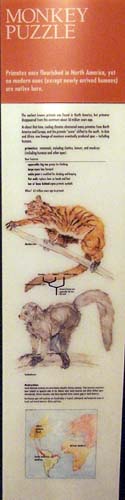
Primates once flourished in North America, yet no modern ones (except newly arrived humans) are native here.
The earliest known primate was found in North America, but primates disappeared from this continent about 30 million years ago.
At about that time, cooling climates eliminated many primates from North America and Europe, and the primate "scene" shifted to the south. In Asia and Africa, one lineage of monkeys eventually produced apes -- including humans.
primates:
mammals, including
Cantius
, lemurs, and monkeys (including humans and other apes)
New features:
- opposable big toe grasps for climbing
- large eyes face forward
- ankle joint is modified for climbing and leaping
- flat nails replace claws on hands and feet
- bar of bone behind eyes protects eyeballs
When? 63 million years ago to present
Monkeyshines
South American monkeys are most closely related to African monkeys. Their ancestors may have been isolated on opposite sides of the Atlantic when South American and Africa drifted apart. Alternatively, African ancestors may have migrated across oceanic gaps to South America.
Non-human apes and monkeys are found today in tropical, subtropical, and temperate areas of South and Central America, Africa, and Asia.
PICTURE CAPTIONS:
- Notharctus
- Smilodectes
- oldest primate fossil
- South American monkeys
- African monkeys
- Diagram showing common ancestry and evolution of Cantius , lemurs, and monkeys/apes from organisms with flat nails, opposable big toes,and forward-facing eyes. Evolution of Cantius and lemurs is where modifications in ankle joint branch off.