THE MOON
The image below is a photo of the exhibit poster. A text transcript follows.
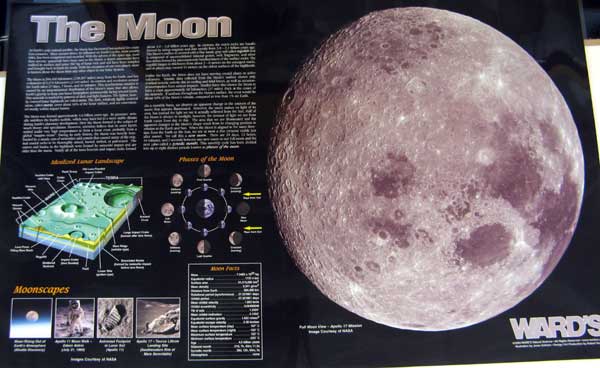
Poster from Ward's -- 2003. Illustration by Jesse Gotham; Design/Art production by Robert Verni.
As Earth's only natural satellite, the Moon has fascinated humankind for countless centuries. Since ancient times, its influence on Earth's cycles, most notably tides, has been recognized and recorded. With the advent of the space age, more than seventy spacecraft have been sent to the Moon; a dozen astronauts have walked its surface; and some 382 kg of lunar rock and soil have been sampled and brought back to Earth for study. With the exception of our own planet, more is known about the Moon than any other object in our Solar System.
The Moon is 384,400 kilometers (238,857 miles) away from the Earth, and has a diameter of 3,476 kilometers (2,160 miles). Its rotation and revolution around the Earth takes 27 days, 7 hours, and 43 minutes. This synchronous rotation is caused by an unsymmetrical distribution of the Moon's mass that also allows Earth's gravity to keep one lunar hemisphere permanently facing toward Earth. This nearside is marked by patterns of dark and light features. The lighter, heavily cratered lunar highlands are called terra. The dark, relatively lightly cratered areas, called maria, cover about 16% of the lunar surface, and are concentrated mostly within impact basins.
The Moon was formed approximately 4.6 billion years ago. Its presence actually stabilizes the Earth's wobble, which may have led to a more stable climate during Earth's planetary development. How the Moon formed is the subject of much theory and speculation. However, scientists believe that its outer layers melted under very high temperatures to form a lunar crust, probably from a global "magma ocean". During its early history, the Moon was heavily bombarded by a steady rain of meteorites and comets that caused many of the original crustal rocks to be thoroughly mixed, buried, melted, or pulverized. The craters and basins in the highlands were formed by meteorite impact and are older than the maria. Nearly all of the terra breccias and impact melts formed about 4.0 to 3.8 billion years ago. In contrast, the maria rocks are basalts formed by rising magmas and date mostly from 3.8 to 3.1 billion years ago. The Moon's surface is covered with a fine sandy gray soil called regolith that is composed of unconsolidated mineral grains, rock fragments, and other fine debris formed by micrometeorite bombardment of the surface rocks. The regolith ranges in thickness from about 2 to 8 meters on the youngest maria and in places may exceed 15 meters on the oldest surface of the highlands.
Unlike the Earth, the Moon does not have moving crustal plates or active volcanoes. Seismic data collected from the Moon's surface shows only residual tectonic activity due to cooling and tidal forces, as well as occasional moonquakes from meteor impacts. Studies have also shown the Moon to have a crust approximately 60 kilometers (37 miles) thick at the center of the nearside. If uniform throughout the Moon's surface, the crust would be about 10% of the Moon's volume, compared to less than 1% on Earth.
On a monthly basis, we observe an apparent change in the amount of the moon that appears illuminated. However, the moon makes no light of its own, but instead the light we see is actually reflected from the Sun. Half of the Moon is always in sunlight, however, the amount of light we see from Earth varies from day to day. The area that we see illuminated and the apparent changes in the Moon's shape result from its changing position in relation to the Earth and Sun. When the moon is aligned in the same direction from the Earth as the Sun, we see at most a thin crescent visible just after sunset. We call this a new moon. There are 29 days, 12 hours, 44 minutes, and 3 seconds between one new moon or one full moon and the next (also called a synodic month). This monthly cycle has been divided into up to eight distinct periods known as phases of the moon.
Image captions:
- Idealized Lunar Landscape: Terra Vs Mare; Old Lava-Flooded Impact Crater; Fault Scarp; Crater Chain; Youthful Crater with Rays; Sinuous Rille; Youthful Crater; Volcanic Domes; Lava Flows Filling Mare Basin; Regolith; Shattered Bedrock; Impact Crater (lava flooded); Fault; Linear Rille (graben type); Brecciated Rocks (formed by meteorite impact before lava flows); Mare Ridge (wrinkle type); Large Impact Crater (formed after lava flows); Ancient crust;
- Full Moon View -- Apollo 17 Mission; Image Courtesy of NASA
- Phases of the Moon: Full Moon; Gibbous (waning); Last Quarter; Crescent (waning); New Moon; Crescent (waxing); First Quarter; Gibbous (waxing)
- Moonscapes
Moon Rising Out of Earth's Atmosphere (Shuttle Discovery)
Apollo 11 Moon Walk -- Edwin Aldrin (July 21, 1969)
Astronaut Footprint in Lunar Soil (Apollo 11)
Apollo 17 -- Taurus Littrow Landing Site (Southeastern Rim of Mare Serenitatis)
MOON FACTS
Mass 7.3483 x 10²² kg
Equatorial radius 1737.4 km
Surface area 61,415,095 km2
Mean density 3.341 g/cm3
Distance from Earth 1384,400 km
Rotational period (synchronous) 27.321661 days
Orbital period 27.321661 days
Mean orbital velocity 1.023 km/s
Orbital eccentricity 0.06490049
Tilt of axis 1.5424°
Mean orbital inclination 5.1454°
Equatorial surface gravity 1.622 m/sec2
Equatorial escape velocity 2.36 km/sec
Mean surface temperature (day) 107° C
Mean surface temperature (night) -153° C
Maximum surface temperature 123° C
Minimum surface temperature -233° C
Age 4.6 billion years
Sidereal month 27d, 7h, 43m, 11.5s
Synodic month 29d, 12h, 44m, 3s
Atmosphere none