PATTER OF LITTLE FEET
The image below is a photo of the exhibit panel. Following it is a transcript of the panel.
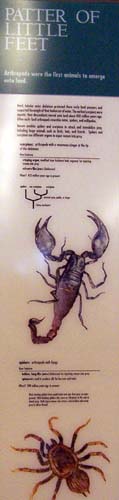
Arthropods were the first animals to emerge onto land.
Hard, tubular outer skeletons protected these early land pioneers and supported the weight of their bodies out of water. The earliest scorpions were aquatic; their descendants moved onto land about 400 million years ago. Other early land arthropods resemble mites, spiders, and millipedes.
Venom enables spiders and scorpions to attack and immobilize prey, including large animals such as birds, bats, and lizards. Spiders and scorpions use different organs to inject venom into prey.
scorpions:
arthropods with a venomous stinger at the tip of the abdomen
New features:
- stinging organ , modified from hindmost body segment, for injecting venom into prey
- scissors-like jaws (chelicerae)
When? 425 million years ago to present
spiders:
arthropods with fangs
New features:
- hollow, fang-like jaws (chelicerae) for injecting venom into prey
- spinnerets used to produce silk for burrows and webs
When? 390 million years ago to present
Most running spiders have good vision and spot their prey on open ground. Web-building spiders rely more on vibrations in the web to detect prey. Both inject venom into victims; web-builders also wrap prey in silken thread.
PICTURE CAPTIONS:
-
Diagram showing common ancestry and evolution of spiders, sea scorpions, and scorpions from organisms with biting mouthparts. Evolution of sea scorpions and scorpions is where terminal spine, paddle, or stinger branches off.