SEA OF GRASS
The image below is a photo of the exhibit panel. Following it is a transcript of the panel.
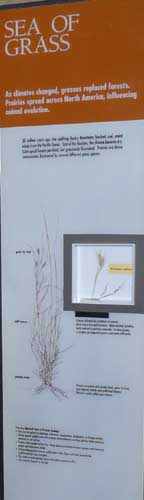
As climates changed, grasses replaced forests. Prairies spread across North America, influencing animal evolution.
30 million years ago, the uplifting Rocky Mountains blocked cool, moist winds from the Pacific Ocean. East of the Rockies, the climate became dry. Subtropical forests perished, but grasslands fluorished. Prairies are dense communities dominated by several different grass species.
Prairies affected the evolution of animals, plant-eaters first and foremost. Wear-resistant grinding teeth evolved in grazing mammals. In some groups, a complex gut digested grasses even more efficiently.
Grasses are plants with jointed stems, grain for fruit, and reduced, mostly wind-pollinated flowers. Mineral crystals stiffen grass leaves.
Fire is a Natural Part of Prairie Ecology
- Fires can be ignited by lightning, volcanoes, spontaneous combustion, or human activity.
- Flames spread rapidly across flat prairies; natural barriers are few, and dry winds minimize moisture in soil and air.
- Pairies offer ample fuel for fire. Dead plants accumulate because grasses resist bacterial attack and decompose slowly.
- Fast-growing grasses recover swiftly after a fire. Roots and buds beneath the surface soil don't get scorched.
- The seeds of some grasses sprout only after exposure to fire.
- Fire returns minerals to the soil.
PICTURE CAPTIONS:
- grain for fruit
- stiff leaves
- jointed stems
- grass 50 million years ago; Wyoming