THE SUN
The image below is a photo of the exhibit poster. A text transcript follows.
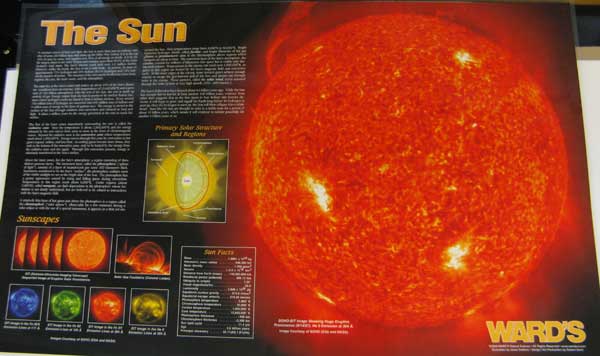
Approximate dimensions: H:22 in W:35 in
WARD's 2003
Images Courtesy of SOHO (ESA and NASA); Illustration by Jesse Gotham; Design/Art Production by Robert Verni
A constant source of heat and light, the Sun is more than just an ordinary star. One of some 200 billion stars that make up the Milky Way Galaxy, it is in the top 10% of stars by mass, and supplies over 99% of all energy on Earth. It is by far the largest object in the Solar System and contains more than 99.8% of the Solar System's total mass. The Sun's interior could hold over 1.3 million Earths. However, unlike the Earth, the Sun is not a solid body. At present, its mass is approximately 75% hydrogen and 25% helium (92.1% hydrogen and 7.8% helium by number of atoms). The structure of the Sun can be divided into three basic regions: the core, the inner zones, and the atmosphere.
The core lies at the Sun's center and makes up about 10% of the Sun's diameter. Conditions here are extreme, with temperatures of 15,600,000°K and a pressure of 250 billion atmospheres. Like the rest of the Sun, the core is made up entirely of gas. Energy output from the Sun is produced by nuclear fusion reactions where hydrogen nuclei are fused to form a helium nucleus. Every second 700 million tons of hydrogen are converted into 695 million tons of helium and 5 million tons of energy in the form of gamma rays. The energy is carried to the surface of the Sun through radiation and convection and released as heat and light. It takes a million years for the energy generated at the core to reach the surface.
The first of the inner zones immediately surrounding the core is called the radiative zone . Here the temperature is about 2,500,000°K and the energy released by the core moves from atom to atom in the form of electromagnetic waves. Beyond the radiative zone is the convective zone where temperatures reach about 1,000,000°K. Energy moves through this zone by convection as hot gases expand, radiate, and lose heat. As cooling gases become more dense, they sink to the bottom of the convective zone, only to be heated by the energy from the radiative zone and rise again. Through this convection process, energy is ultimately transferred to the Sun's surface.
Above the inner zones, lies the Sun's atmosphere, a region consisting of three distinct gaseous layers. The innermost layer, called the photosphere ("sphere of light"), consists of a layer of incandescent gas some 300 kilometers thick. Sometimes considered to be the Sun's "surface", the photosphere radiates most of the visible sunlight we see as the bright disk of the Sun. The photosphere has a grainy appearance caused by rising and falling gases during convection. Temperatures in this region reach about 6,000°K. Cooler regions (about 3,800°K), called sunspots , are dark depressions in the photosphere whose formation is not clearly understood, but are believed to be related to interactions with the Sun's magnetic field.
A relatively thin layer of hot gases just above the photosphere is a region called the chromosphere ("color sphere"). Observable for a few moments during a solar eclipse or with the use of a special instrument, it appears as a thin red rim around the Sun. Here temperatures range from 4,000°K to 50,000°K. Bright luminous hydrogen clouds, called faculae , and bright filaments of hot gas ( flares or prominences ) arise in the chromosphere above regions where sunspots are about to form. The outermost layer of the Sun's atmoshere, the corona , extends for millions of kilometers into space but is visible only during total eclipses. Temperatures in the corona can reach over 1,000,000°K, as gases in this region are heated by the Sun's magnetic field and convective cycle. At the outer edges of the corona, some ionized gases achieve enough velocity to escape the gravitational pull of the Sun and stream out through holes in the corona. These particles, called the solar wind, travel outward through the Solar System at very high speeds (250 - 800 km/sec.).
The Sun is believed to have formed about 4.6 billion years ago. While the Sun has enough fuel to last for at least another 100 billion years, evidence from other stars suggests that as the Sun starts to fuse helium into heavier elements, it will begin to grow and engulf the Earth long before its hydrogen is used up. Once the hydrogen is used up, the Sun will then collapse into a white dwarf. Stars like the Sun are thought to exist in a stable state for a period of about 10 billion years, which means it will continue to radiate peacefully for another 5 billion years or so.
Image caption: Primary Solar Structure and Regions (Corona, Prominence, Sunspots, Chromosphere, Photosphere, Convective Zone, Radiative Zone, Core)
Image captions for Sunscapes:
EIT (Extreme-Ultraviolet Imaging Telescope) -- Sequential Image of Eruptive Solar Prominence;
Solar Gas Fountains (Coronal Loops);
EIT Image in the Fe IX/X Emission Lines at 171 A;
EIT Image in the Fe XII Emission lines at 195 A;
EIT Image in the FeXV Emission Lines at 284 A;
EIT Image in the He II Emission Lines at 304 A;
SOHO-EIT Image Showing Huge Eruptive Prominence (9/14/97).
He II Emission at 304 A.
SUN FACTS
Mass 1.9891 x 10
30
kg
Volumetric mean radius 696,000 km
Mean density 1.408 g/cm
3
Volume 1.412 x 10
18
km
3
Distance from Earth (mean) 149,600,000 km
Rotational period (sidereal) 609.12 hrs
Obliquity to ecliptic 7.25°
Visual magnitude (V
o
) -26.8
Luminosity 3.846 x 10
26
J/s
Equatorial surface gravity 274.0 m/sec
2
Equatorial escape velocity 618.02 km/sec
Photosphere temperature 5,800° K
Chromosphere temperature 30,000° K
Corona temperature 1,000,000° K
Core temperature 15,600,000° K
Photosphere thickness ~400 km
Chromosphere thickness ~2,500 km
Sun spot cycle 11.4 yrs
Age 4.6 billion years
Principal chemistry 92.1%(H) 7.8%(He)