WARM BLOOD, COLD WATER
The image below is a photo of the exhibit panel. Following it is a transcript of the panel.
Some mammals abandoned land and adapted to life in the sea. They share an ancestor with the wolf-like
Pachyaena
.
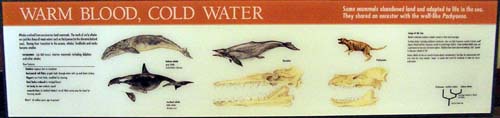
Whales evolved from carnivorous land mammals. The teeth of early whales are just like those of meat-eaters such as Pachyaena (in the diorama behind you). During their transition to the oceans, whales' hindlimbs and necks became smaller.
Cetaceans
(sih-
TAY
-shunz): marine mammals including dolphins and other whales
New features:
- Blubber replaces hair as insulation
- Horizontal tail fluke propels body through water with up-and-down strokes
- Flippers are front limbs, modified for steering
- Hind limbs reduced to vestigial bones
- Fat body in ear conducts sound
- Acoustic lens (in toothed whales): an oil-filled cavity atop the head for focusing sounds
When? 50 million years ago to present
Songs of the Sea
Modern cetaceans produce complex sounds in their nasal passages.
Toothed whales (including dolphins) echolocate: they use high frequency sounds to locate small objects (food) and low frequency sounds to avoid larger objects. Some toothed whales may use sound waves to stun prey for easier capture. Dolphins have been observed making "click" sounds to disorient schools of fish.
Baleen whales do not use sound to locate objects (echolocation), but they do communicate with each other by using complex "songs" or sounds that travel for hundreds of miles (or more) under water.
PICTURE CAPTIONS:
- Baleen whale (gray whale -- Eschrichtius robustus )
- Toothed whale (killer whale -- Orcinus orca )
- Dorudon
- Skull
- Pachyaena
- Skull
- Diagram showing common ancestry and evolution of Pachyaena , toothed whales, and baleen whales from organisms with a narrow lower jaw. Evolution of tail fluke and hind legs reducing or absent is where whales branch off.
This panel describes a true-scale diorama filled with animals, such as the Pachyaena. That diorama was part of an exhibit originally installed at the California Academy of Sciences. It is not present here at CCSF.