WINGING IT
The image below is a photo of the exhibit panel. Following it is a transcript of the panel.
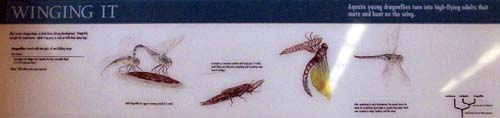
Aquatic young dragonflies turn into high-flying adults that mate and hunt on the wing.
Most insects change shape, or body form, during development. Dragonfly nymphs live underwater. Adults trap prey in mid-air with their spiny legs.
dragonflies:
insects with two pairs of non-folding wings
New feature:
-
two pairs of wings
work together for fast, controlled flight (15 to 25 miles per hour)
When? 300 million years ago to present
PICTURE CAPTIONS:
- Adult dragonflies lay eggs in swampy ground or in water.
- A nymph is a voracious predator with large jaws. It stalks small fishes and other prey, propelling itself by jetting water from its hindgut.
- After completing its early development, the nymph leaves the water. Its exoskeleton bursts open to reveal a limp adult, which soon expands its wings, hardens, and flies away.
- Diagram showing common ancestry and evolution of crustaceans, centipedes, and dragonflies from organisms with a head fused from six body segments. Evolution of centipedes and dragonflies is where only pair of antennae branches off.