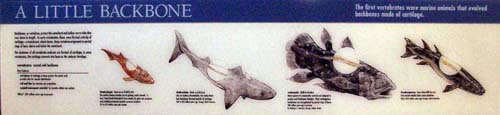
The first vertebrates were marine animals that evolved backbones made of cartilage.
Backbones, or vertebrae, protect the notochord and hollow nerved tube that runs down its length. In early vertebrates, these were formed entirely of cartilage -- a translucent, elastic tissue. Bony vertebrae originated as partial rings of bone above and below the notochord.
The skeletons of all vertebrate embryos are formed of cartilage; in some vertebrates, the cartilage converts into bone as the embryo develops.
vertebrates animals with backbones
New features:
- vertebrae of cartilage or bone protect the spinal cord, provide sites for muscle attachment
- tails and fins for steering and propulsion
- eyeball movement controlled by muscles within eye sockets
PICTURE CAPTIONS:
- Hemicyclaspis (hem-ee-sy-CLASS-piss)
This jawless bottom-dweller ate by gulping small animals. A bony head-shield defended it from attacks by giant sea scorpions and probably protected sensitive sensory receptors
395 to 370 million years ago; Europe - Cladoselache (klad-o-sel-A-kee)
Like its modern descendants, this early shark had backbones formed entirely of cartilage.
350 to 345 million years ago; Europe, North America - Coelacanths (SEE-la-kanths)
Many species of coelacanths evolved and adapted to marine and freshwater habitats. Their cartilaginous backbones are strengthened by partial rings of bone.
380 million years ago to present; N. America, S. America, Europe, Indian Ocean - Eusthenopteron (yoo-sthen-OP-ter-on)
This ancient lobefin had a bony skeleton.
360 to 345 million years ago; Europe, North America