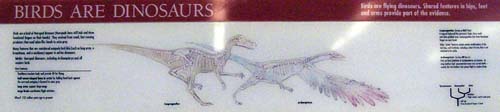
Birds are flying dinosaurs. Shared features in hips, feet and arms provide part of the evidence.
Birds are a kind of therapod dinosaur (therapods have stiff tails and three functional fingers on their hands). They evolved from small, fast-running predators that used talon-like hands to seize prey.
Many features that are considered uniquely bird-like (such as long arms, a breastbone, and a wishbone) appear in earlier dinosaurs.
birds: therapod dinosaurs, including Archaeopteryx and all modern birds
New features:
- feathers insulate body and provide lift for flying
- half-moon-shaped bone in wrist for folding hand back against the arm and swinging it forward to seize prey
- long arms support large wings
- large brain coordinates flight activities
- half-moon-shaped bone in wrist for folding hand back against the arm and swinging it forward to seize prey
Compsognathus (komp-so-NAY-thus)
A long tail balanced this carnivore's body; sharp teeth and claws grabbed prey. Compsognathus had three functional fingers on each hand.
Other "avian" features include certain modifications of the tail, hips, and hindlimbs, including a short first toe that is not attached to the ankle.
Archaeopteryx (ar-keeOP-ter-ix)
Only six fossil skeletons of Archaeopteryx are known. Its wing feathers had asymmetrical vanes and curved shafts -- exactly like the feathers that power flight in modern birds.
PICTURE CAPTIONS:
- Compsognathus
- Archaeopteryx
- Diagram showing common ancestry and evolution of Tyrannosaurus, Deinonychus, and birds from organisms with a stiff tail and three functional fingers in hand. Evolution of Deinonychus and birds is where a wishbone and "flight stroke" used to seize prey branch off.