|
For two billion years (nearly two thirds of our planet's history) single cells were the only forms of life on earth. Today, single-celled organisms are the most widely distributed life forms. They thrive almost everywhere, from arctic ice to hot sulphur springs. The earliest cells are known from fossils. Some of these divided to form ball-shaped or thread-like structures. By 3.5 billion years ago, many forms of single-celled life existed.
Life: a system that is able to convert raw materials from its environment into identical, or nearly identical, copies of itself. Occasionally, slight changes occur during the copying process, resulting in offspring with individual differences -- from which new features can arise, and upon which evolutionary change depends.
|
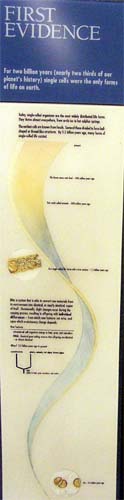 Transcript of Panel Text and Description of its Pictures Follows |
-
PICTURE CAPTIONS:
- Life -- 3.8 billion years ago
- First single-celled life forms with a true nucleus -- 1.5 billion years ago
- First multi-celled animals -- 600 million years ago
- Life forms move onto land -- 430 million years ago
- Present
- Diagram showing common ancestry and evolution of cyanobacteria, plants, animals, red algae, and brown algae from organisms with DNA and the ability to feed, grow, reproduce, and evolve.
Time Ribbon