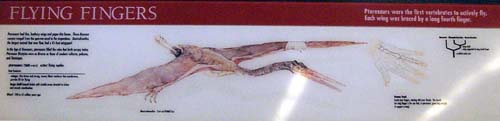
Pterosaurs were the first vertebrates to actively fly. Each wing was braced by a long fourth finger.
Pterosaurs had thin, leathery wings and paper-thin bones. These dinosaur cousins ranged form the sparrow-sized to the stupendous. Quezalcoatlus, the largest animal that ever flew, had a 45-foot wingspan!
In the Age of Dinosaurs, pterosaurs filled the roles that birds occupy today. Pterosaur lifestyles were as diverse as those of modern vultures, pelicans, and flamingos.
pterosaurs (TARE-o-sorz): extinct flying reptiles
New features:
- wings: thin bones and strong, sinewy fibers reinforce thin membranes, provide lift for flying
- large skull housed brains with sizeable areas devoted to vision and muscle coordination
PICTURE CAPTIONS:
- Quezalcoatlus (ket-zal-KWAT-lus)
- Human Hand
Count your fingers, starting with your thumb. The fourth (or ring) finger is the one that, in pterosaurs, grew long enough to support a wing! - Diagram showing common ancestry and evolution of dinosaurs, Rhamphorhynchus, and Quetzalcoatlus from organisms with modified ankle joint. Evolution of large skull and wing supported by long fourth finger is where Rhamphorhynchus and Quetzalcoatlus branch off.