|
Organisms with hard bits of shell first appeared about 600 million years ago -- the beginning of an extensive fossil record. Tiny shells are the first hard parts that appear in the fossil record. Some were whole shells; others may have been plates or pieces that covered parts of a work-like animal, rather than housing the whole creature. Hard parts probably evolved as animal communities became more complex. Most animals lived on the ocean bottom until about 600 million years ago, when many became burrowers, active surface predators, or swimmers. Hard parts probably evolved to support muscles and as defense against predators. The sudden abundance of hard shells in the fossil record could represent one of the following:
|
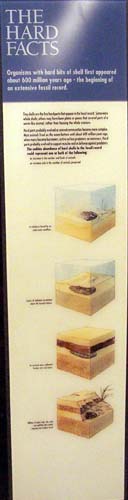 Transcript of Panel Text and Description of its Pictures Follows |